Category: Commercial

Bespoke Commercial

  • Uchi Houston Host/Hostess Stand

    Uchi Houston Host/Hostess Stand

    host4

    I was approached by the company managing the highly acclaimed Uchi restaurants in Texas area for a revamp of the host and hostess stand there. The original one was made out of walnut plywood and it had been showing some wear and tear for awhile now. My clients wanted to use locally sourced spalted pecan to match the other furniture in the restaurant. 

    [singlepic id=268 w= h= float=center]

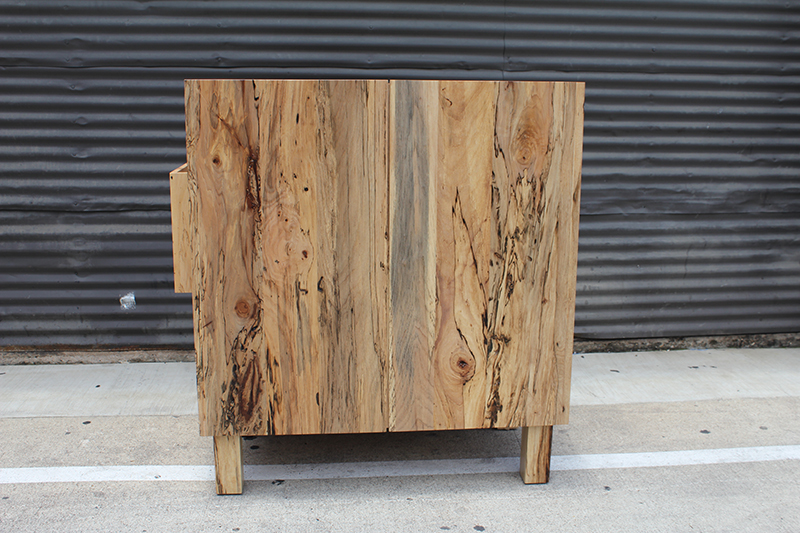
    I went to my favorite local sawmill Berdoll Sawmill in Cypress Creek, TX to get the spalted pecan. Spalted wood is beautiful, but it can be too busy if used without restraint. The front, sides, and the legs are spalted pecan, but everything else is made from hickory plywood to give it a nice contrast without the contrast being too stark. I allowed a expansion gap in the center of the front so the solid wood pecan could move freely without cracking. 

    [singlepic id=267 w= h= float=center]

    This new host stand was an opportunity to correct/add details that improved the functionality of the host stand. The first improvement was creating one of the legs hollow so the power cord can be discreetly fed through the cabinet and up to the top surface. Another improvement was creating a recessed area for the monitor to sit in. The clients wanted the customer’s first interaction with the friendly hosts and hostess to be unobstructed by distractions. The sides and the front is raised up front the top surface for this purpose- to hide any clutter that accumulates during a busy dinner service. 

    [singlepic id=266 w= h= float=center]

    In the cabinet, there are 3 doors, 1 drawer, and 1 cubby area. On the side, there is a little menu holder made out of spalted pecan. I chose a toned down board of spalted pecan for the menu holder so there’s a bit of a contrast. 

    [singlepic id=270 w= h= float=center]

    This was a fun project that meant a great deal to me. When I first moved to Austin and I was looking for a job, I worked as a prep chef there briefly until I could get my bearings in town and go work for a guitar maker. I recall my brief time there with warmth. The chefs and everyone there were extremely friendly and the buzz I felt during dinner service was intoxicating. I always wonder what would have happened if I stayed there instead of pursuing my woodworking career. 
     

  • FWC-18′ conference table

    FWC-18′ conference table

    fwc18-9

    The good people of Far West Capital are so awesome that their business and staff just keeps getting bigger and bigger. I had made a 12′ conference table for them a few years ago, and they’ve already outgrown that one, so they commissioned me to make a 18′ conference table this time. They loved the traditional meets modern aesthetic of the last one, so we decided to design something that looks totally different from the last one, yet feels similar.

    [singlepic id=162 w=320 h=240 float=center]

    This was by far the biggest project I’ve had the opportunity to work on and logistics became the first and foremost in the design aspect. How can I make these parts in my shop and how can I break the pieces up so I can move it safely and easily? I decided that the top will be made from 3 parts and I wanted to make the top as light as possible since that has the biggest area. To support the top, there are thick and wide aprons that come apart and fit together with notches made in the wood. This gives stability to an otherwise flexible top. The aprons rest on pedestals that are angles and tapered in almost every direction. The taper came from trying to gain as much foot space as possible without sacrificing stability. One side of the pedestal is held in with clips so you can remove it to store and hide conference table equipment. At the feet there is a 1/4″ blackened plate steel that adds weight and distributes the footprint out so the top wont tip over.

    [singlepic id=145 w=320 h=240 float=center]

    The whole table is made from peruvian walnut veneered panels with solid wood edging. The removable center piece is made of spalted beech. Spalted is a figure in wood caused by fungal attack. The wood is left for fungus to attack, but then harvested before the wood rots completely and becomes unusable. It’s characteristics are black vein like lines with wood tones around it being different. I think the spalted beech was a nice compliment to the peruvian walnut and adds a little bit of country to the otherwise sophisticated elements.

    [singlepic id=147 w=320 h=240 float=center]

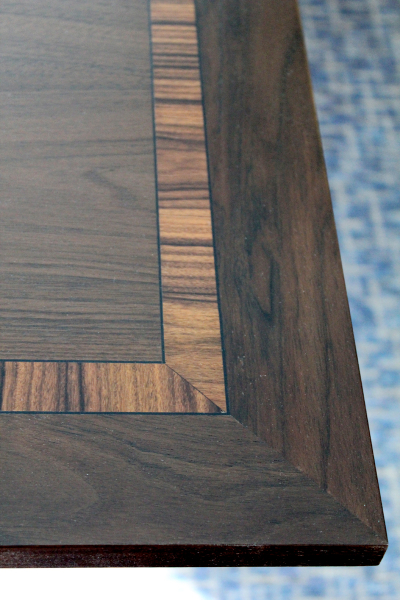
    To break up the large dark surface and to give a nod to traditional furniture we chose to inlay cross banding around the border. Cross banding is inlayed wood that is aligned so the grain is oriented side to side across the length. The outer cross banding is made from Bolivian rosewood and the inner cross banding that borders the spalted beech is Macassar Ebony. I feel the different tones in the woods give a nice transition to the different woods.

    [singlepic id=144 w=320 h=240 float=center]

    Sixteen people can sit all around the table easily and maybe a few more if people are willing to get close and cozy with each other. I think this design is a success because the real design elements are in the small details.


  • Tambour sideboard

    Tambour sideboard

    sideboard9

    I was approached to design a credenza/sideboard that matches a conference table I made in the past. A+L Conference Table. The main purpose for the sideboard was a storage unit that housed all their conferencing equipment when they weren’t using it as well as all the wires and misc things that should be hidden when it’s not used. The sideboard also makes a great platform to showcase all the awards they have won in the past.

    [singlepic id=124 w=320 h=240 float=center]

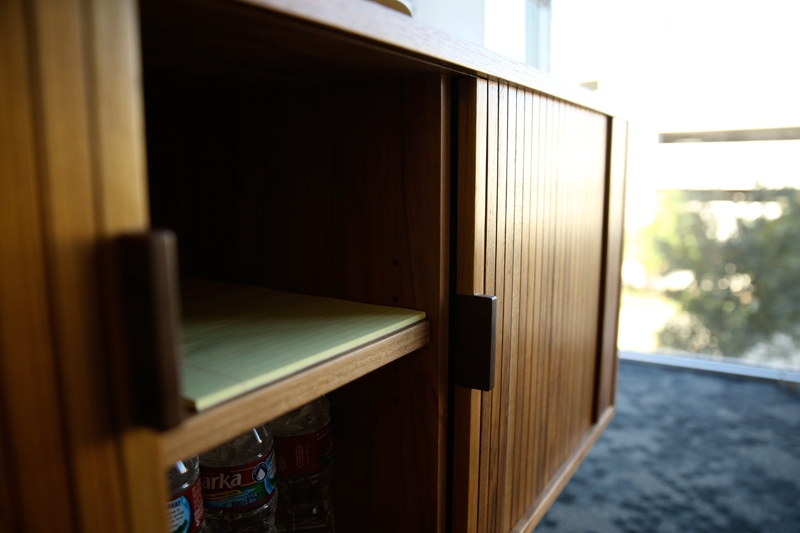
    Since there wasn’t a whole lot of space between the wall and the conference table chairs, I wanted to avoid having a door that swings out- especially if they needed the cabinet open for one reason or another. That left me with sliding doors or tambour doors as the options for the doors. Tambours are doors that slide in a track and roll so that it’s able to tuck into the sides and hide behind the back panel. You see this used on roll top desks.

    [singlepic id=127 w=320 h=240 float=center]

    After our design meeting, the client and I both agreed that tambours were the better choice for this situation. Not only does it look nicer, it’s a better solution functionally since you can reveal just the center shelf area, or open it all the way to showcase the whole interior of the cabinet. I also believe tambours have a certain nostalgic feeling that reminds us of beautiful furniture of the past.

    [singlepic id=130 w=320 h=240 float=center]

    The design inspiration came from mid-century modern furniture. I think the simplicity in form of the designers of this era got it just right. It’s hard to improve upon it, so I left the lines as clean as possible and tried to let all the details shine. Like many of SYD furniture, the eye is in the detail and the craftsmanship. Spend time on those elements and you don’t need fancy or unusual forms to stand out.

    [singlepic id=125 w=320 h=240 float=center]

    Most of the furniture in the room is made of pecan, so pecan was the natural choice of wood for this project. We didn’t want the room to look like a forest of pecan, so we decided to make the tambour doors out of a different, but complimentary wood. In this case, we decided on teak. The warm color of teak and the rich grain makes the door the focal point without taking all of the spotlight.

    [singlepic id=129 w=320 h=240 float=center]

  • Far West Capital Conference Table

    Far West Capital Conference Table

    FWC Conference TableAfter seeing the conference table I had built for Arts + Labor, my client wanted a table with the same level of impressiveness. He told me that upon walking into the Arts + Labor conference room, he was immediately struck by the conference table. He couldn’t pin point what had made it special, just that it left him wanting one like it. “I want a table that stands out.”
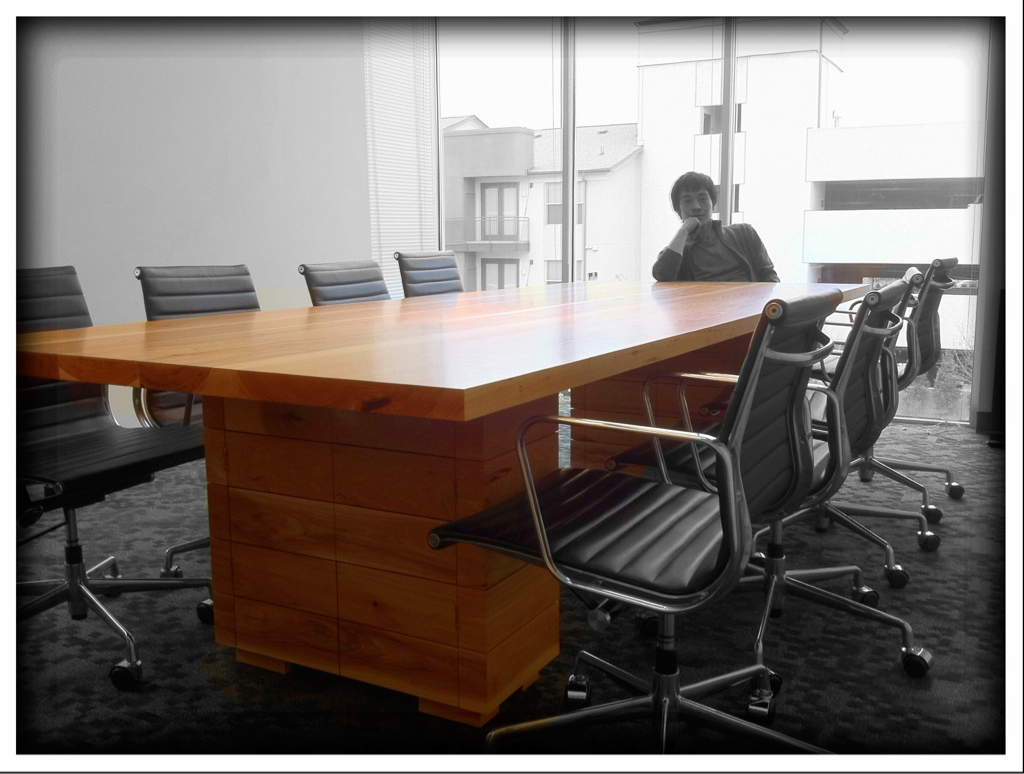
    [singlepic id=55 w=320 h=240 mode=watermark float=center]

    Now, Far West Capital is a rapidly growing financial company that specializes in giving loans to small businesses. More on what they do at http://www.farwestcap.com/. To me, the most important traits any business that is in the business of loans need to convey is trust and stability. People need to know that they can trust these people and that they will be around for a long time. I started thinking about timeless designs and wanted to root this design on traditional design. Look at any cathedral or old houses and there are certain aspects that still remain relevant to us today. I wanted this table to be something that people generations from now will still nod their head in approval.

    [singlepic id=52 w=320 h=240 mode=watermark float=center]

    Traditional or period furniture is nice and can convey timelessness, but our tastes have changed since then and will continue changing. Contemporary design strips detail and decoration down to clean and simple lines, so I looked for the designs that best matched those principles. I found them in Regency and Federal furniture- they are simple forms with just enough detail to add character.

    [singlepic id=53 w=320 h=240 mode=watermark float=center]

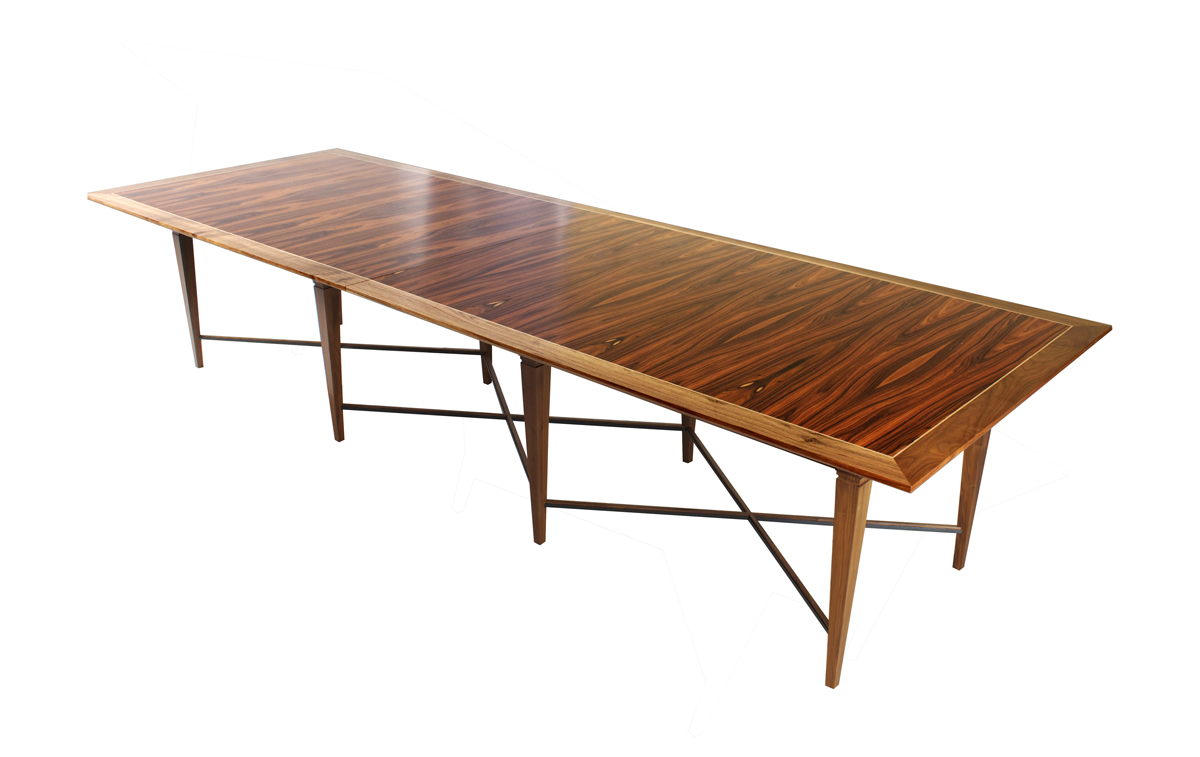
    The table is made entirely of American Walnut except for the table top, which is Pau Ferro, aka Santos Rosewood or Bolivian Rosewood. For this design, most of the focus is centered to the top, so Wow factor needs to be there. I chose Pau Ferro because the color matches the walnut and the grain is just gorgeous. With the finish on there, the table just pops out at you. One principal I live by is “If you have beautiful looking wood, don’t do anything to it. Just let it do it’s thing.”

    [singlepic id=51 w=320 h=240 mode=watermark float=center]

    One other key design element is the cross rails towards the bottom of the legs. Without those, the element of repetition is lost (8 legs). I felt the legs needed to be tied in together somehow visually, but not necessarily structurally. Hence, the thin cross rails. To prevent people from kicking it and snapping the delicate rails off, I reinforced it with steel, which doubles to highlight the X shape.

    [singlepic id=54 w=320 h=240 mode=watermark float=center]

  • Arts + Labor Conference Table

    Arts + Labor Conference Table

    [singlepic id=14 w=960 h=720 mode=watermark float=center]

    Arts and Labor <http://www.arts-and-labor.com> is an Austin based media and video production company that have created award winning commercials and films. The company started small, but with the help of a group of very creative talents, soon became a fast growing company with major projects lined up. Over the years, their business grew so much that they had to move into a bigger space.

    Arts and Labor came to me in December 2010 after they found the space they were going to move into. Their office space was designed by Michael Hsu Office of Archtiecture <http://www.hsuoffice.com/>, an influential architecture/ design firm in Austin. If you happen upon an interesting and well designed restaurant or shop here in Austin, chances are it was created by Michael Hsu’s firm.

    [singlepic id=25 w=640 h=480 float=center]

    Knowing that Michael Hsu Office of Architecture was the designer for the remodel gave me a place to start. I wanted my table to fit in with Michael Hsu’s style, while also keeping a bit of individuality for the time when Arts+Labor gets big enough to move onto a bigger space yet again. Therefore, my focus on the design was adaptability. The company is fast growing, getting bigger everyday, so I wanted the owners to be able to install conference table equipment as needed. For legs or pedstals, I decided on turning them into cabinets with doors that open up for storing equipment and running wires through. I’ve cut out notches and left space in rails, stretchers, and bases so wires could be fed through to almost any point in the table without having to tear the table apart.

    [singlepic id=22 w=640 h=480 float=center]

    Next, came the aesthetics. I noticed Michael Hsu has a common design element in most of his buildings where he has splats that run across a surface like the siding of a house or wood flooring, only with a little bit of a gap in between each panels. (I have no idea what the technical terminology for it is, so I will just call it splat panels.) I incorporated that design element but broke up the sections even more into rectangles to create better proportions and also, to hide the locations of the doors.

    [singlepic id=24 w=640 h=480 float=center]

    Then, the clients and I tightened up the design so it was custom fit for them and came to the conclusion to use pecan for the table. I had the choice of making the inside of the cabinet/pedestals/legs out of plywood, but I decided against it to keep the continuity of solid wood going. I also chose to make the structure as a frame so the splat panels will be visible from the inside as well. What makes this conference table a success is the nice proportions and the simplicity. Everything looks clean, which lets people focus more on the fine details.

    photo credit:
    http://www.hsuoffice.com/projects-commercial-artslabor.html
    http://www.midtowncommons.com/Default.aspx