Category: Tables

Bespoke Tables

  • Carter Table

    Carter Table

    carter5
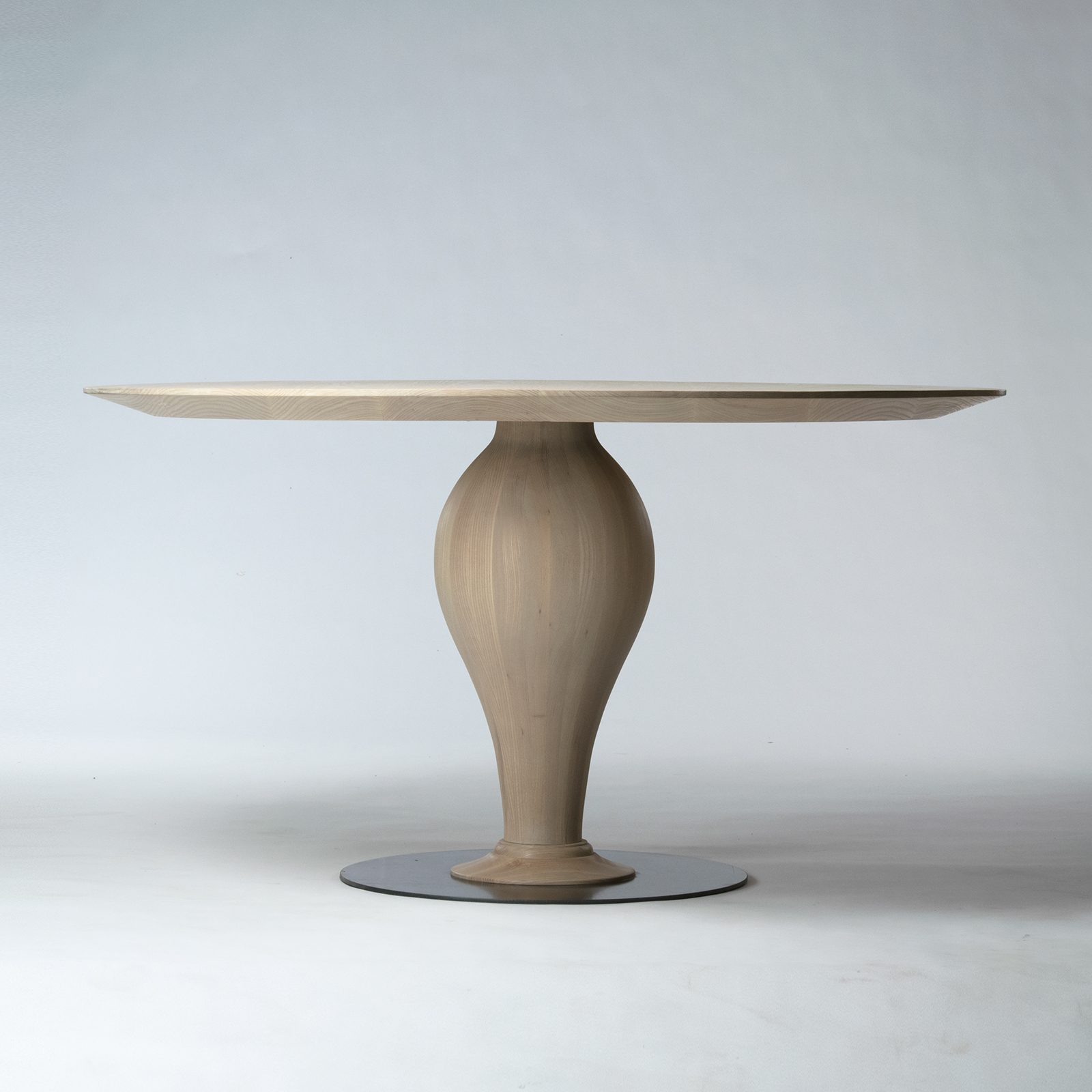
    Tim Cuppett Architects approached me with creating this table for a hill-country retreat they were creating for their client. The design process came about as a collaboration with them.

    They needed a kitchen table for everyday use that’s separate from the big dining room table. This would be the table they would use the most often for daily use- casual eating, conversations, homework, coffee drinking, etc. In other words, it had to be made to withstand the daily toil, but still be elegant. Space was limited, so the round table was a natural choice.

    [singlepic id=301 w= h= float=center]

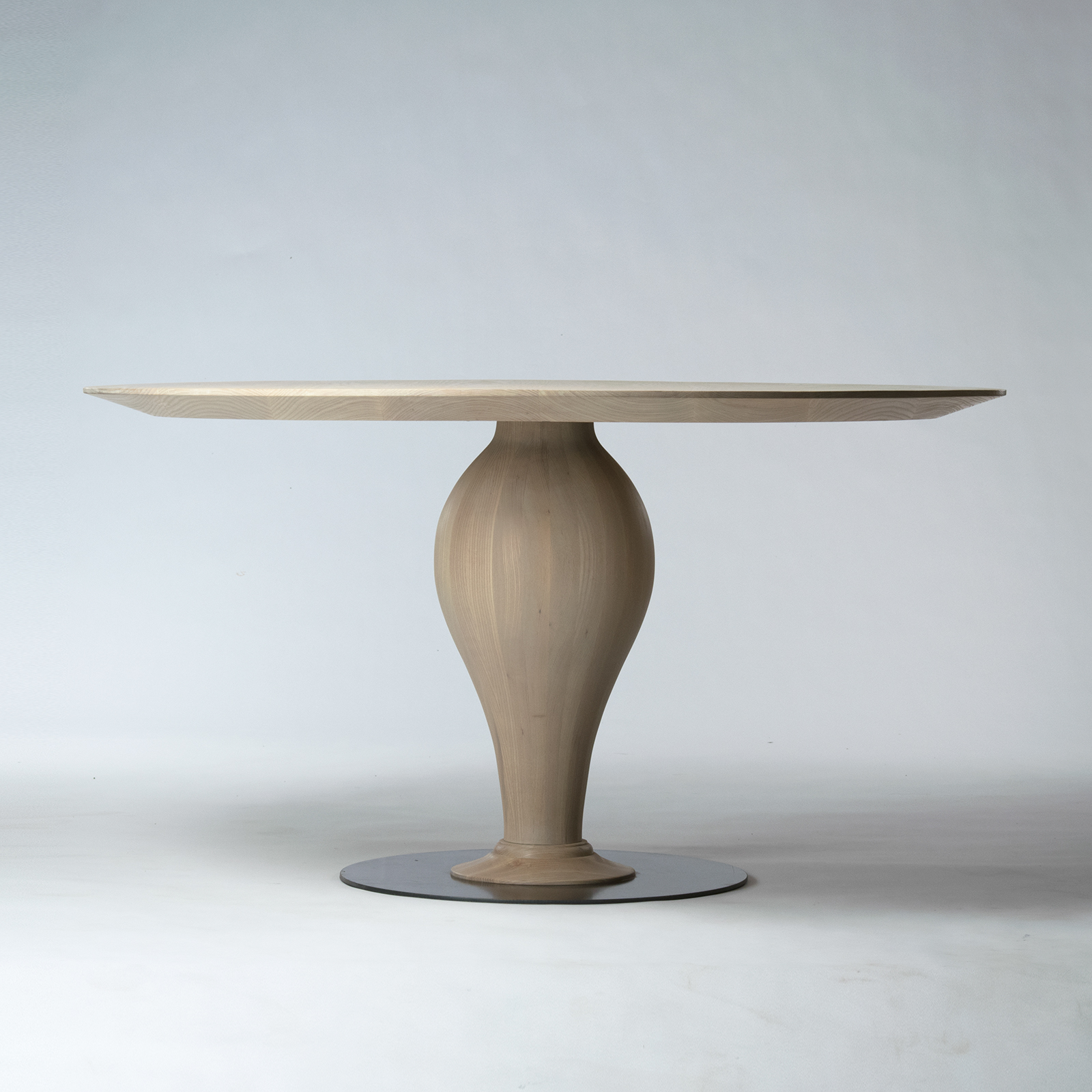
    The design was driven from the chair backs of the client’s family heirloom dining chairs. The chair had a queen anne style back, so we took that form and transformed it into the pedestal base. Because we didn’t want to see wood lamination joint lines as we cut the extreme curves, we glued up the base in a coopering technique. The ash wood was selected to get the straightest grain possible to keep the lines flowing smoothly.

    [singlepic id=299 w= h= float=center]

    The top is actually a thick top, but we cut a large bevel around the perimeter to create a knife edge to keep the top visually light. It also allows for more view of the pedestal base. There is a metal framework inlayed into the underside of the top to keep everything flat and allows for a strong connection to the base.

    [singlepic id=300 w= h= float=center]

    For a narrow pedestal base like this, the footing is always an issue. Most traditional pedestal bases have a large wooden structure (usually in a claw foot detail) that would have destroyed the whole look, so we went for a much cleaner and more modern look by adding a steel plate as the feet. Creating a thin profile for the bottom really highlights the shape of the pedestal without sacrificing structural integrity or making a tipsy table.

    [singlepic id=302 w= h= float=center]

    The table was finished in white oil that kept the wood looking as natural as possible.
  • HEX game table

    HEX game table

    hex6

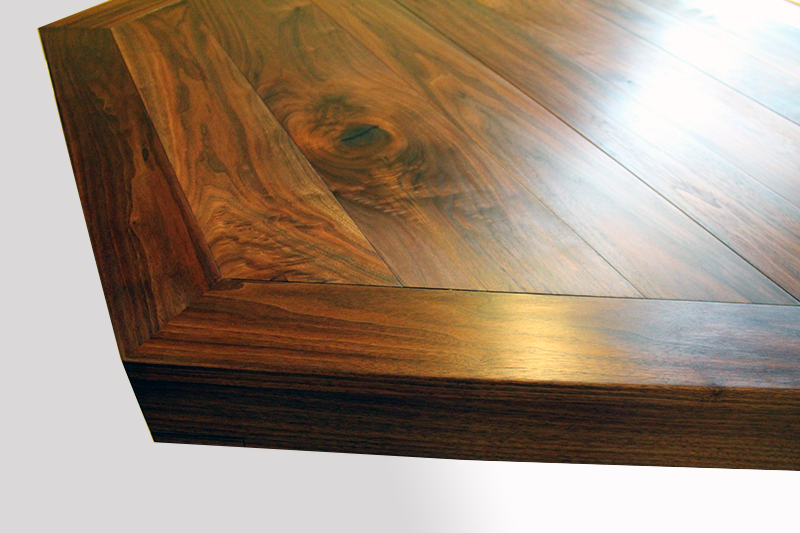
    My Client approached me wanting to create a game table for his family using his family Walnut that had been passed down the generation from his grandfather to his father and then down to him. My client would move the lumber everywhere he went until he could find out what exactly to build with it. 

    [singlepic id=251 w= h= float=center]

    Being an avid gamer, he and his family enjoys getting together to play role playing games where the games could go on for hours and possibly days. He wanted to be able to pause the game with all the pieces intact and in the meantime be able to keep everything from getting moved accidentally until the game would continue. After some research, we came to the split level design where the playing area is sunken in and there is a solid wood table top insert that can go on top to cover up the playing area. We also decided on having the game table hexagon shaped to better fit the room and so everyone is close together. 

    [singlepic id=252 w= h= float=center]

    The playing area is covered with gaming felt so it accommodates several types of games. There is also a plexi-glass insert so game maps can be inserted underneath without damaging it.

    [singlepic id=250 w= h= float=center]

    Since the table is six sided, we decided on a three-legged pedestal table base with a padauk inlay going down the center of each of the legs.

    [singlepic id=249 w= h= float=center]

    The client’s walnut had been air-dried so the walnut hadn’t lost it’s vibrant color as commercial steam dried walnut tends to do. Knowing that the lumber itself has a story makes it that much more of a pleasure to work with. I know this piece of furniture will be handed down the generations just like the lumber was.

    [singlepic id=248 w= h= float=center]

  • Sapele Round Table

    Sapele Round Table

    harmonsonround1

    This table was commissioned to be a meeting table for guests and clients at my client’s office. I had previously created other furniture for his office in a style that mixes traditional details and arranged in a modern way – Harmonson Desk & Harmonson Credenza. I wanted to keep those same ideas with this round table, so I worked on blending the traditional elements with modern elements without one being over bearing.

    [singlepic id=179 w=320 h=240 float=center]

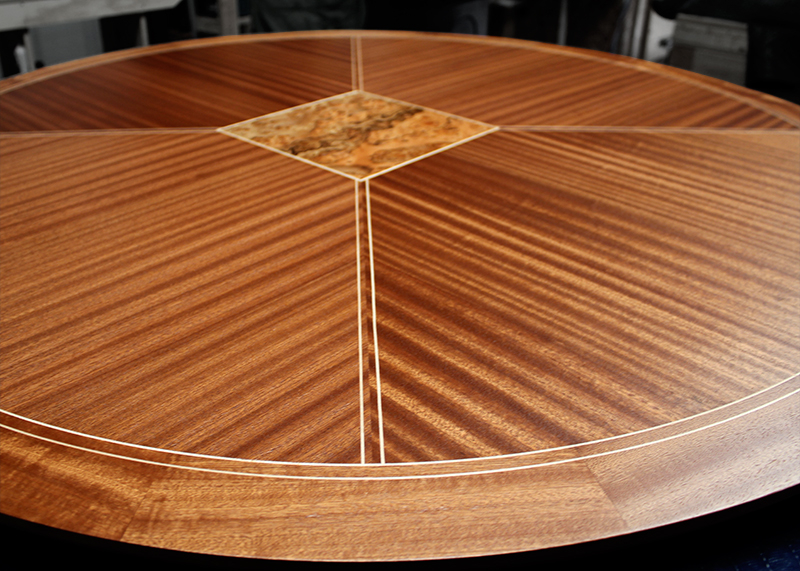
    The top is a beautiful 1/16″ thick ribbon striped sapele veneered top. The perimeter of the top is made out of solid wood not only for looks, but for protection. I arranged the sapele veneers in quarter section so that each quarter lines up to meet in the center. This pattern creates a V- pattern where each sections meet. Since I was able to get a nice consistent line, I didn’t want to hide it so I decided that instead of doing a single inlayed line, I would do a double line and have the V-pattern become another focal point. Having that double line also meant that the lines need to terminate to the perimeter in a thoughtful and graceful way so I decided on another double line that follows the curve of the top.

    [singlepic id=177 w=320 h=240 float=center]

    To keep the modern element, I decided on a tapered square pedestal base. The sapele is used again for the panels, which sticks out 3/16″ to create a three dimensional element. The framework is blackened hard maple. A lot of the design elements of this round table is actually based on a square- the tapered pedestal base and the top being broken into quarters- so I wanted to follow that theme and create a square centerpiece with a decorative wood (pepperwood burl). I think the square ties the top and the base together.

    [singlepic id=178 w=320 h=240 float=center]

    The square is oriented so it looks like a diamond with the double maple inlay stringing terminating at each of the corners. I’m very happy with the combination of sapele and pepperwood burl together. The tones compliment each other and the straight lines of sapele counter-act the free form wazy grain of the pepperwood burl.

    [singlepic id=176 w=320 h=240 float=center]

  • Outdoor Tables + Benches

    Outdoor Tables + Benches

    bergoutdoor1

    My clients have a backyard garden area that would be the envy to anyone. The landscape architect designed an elegant area where people can hang out and socialize next to freshly growing vegetables, with the smell of smoke and cooking from the grill, and enjoying good company under an arbor with fruitless bradford pear trees

    [singlepic id=152 w=320 h=240 float=center]

    The arbor  was started a few years ago and is just now getting to be filled out so my clients wanted to get a nice outdoor table to dine under. They wanted something classy that blends in with the landscape, but without being too rustic. They have a few stone sculptures that reminded me of a Tuscan winery so I started looking for inspiration in books, but all I could see were weathered and beaten up gray farm style tables. That weathered look is nice, but I didn’t think it would look good in their backyard. I also think people should grow up with their furniture and see it weather themselves through the years instead of getting furniture already weathered- their history unknown.

    [singlepic id=150 w=320 h=240 float=center]

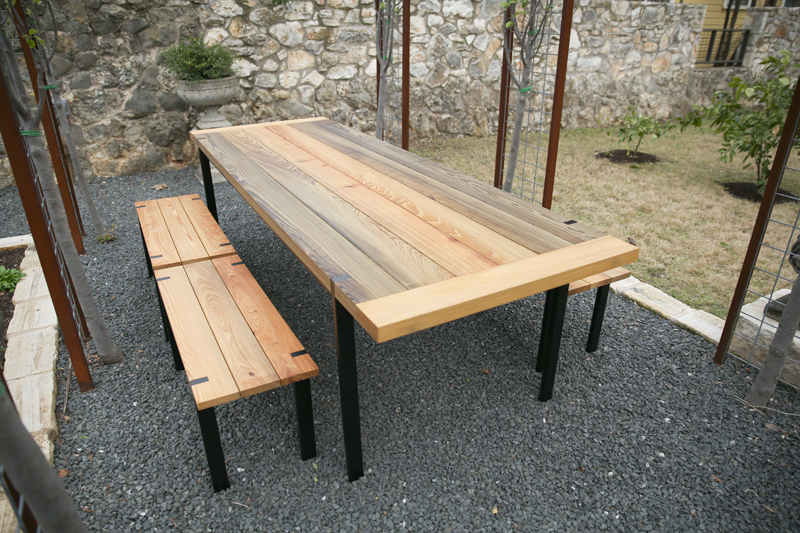
    I took inspiration from the arched arbors. At first I wanted to incorporate arches into the design but decided that it was too obvious and predictable so I took the same elements from the supports that hold up the arches. The archway supports were made from 1″x2″ rectangular tubing, so that became my choice of material. When you step away from under the archway, the 1×2 lines going vertical becomes a strong element so I wanted to emphasize that vertical line. To do that, I let the legs shoot straight through the top so it’s visible from all around. This cohesion actually makes the two different material distinct in my opinion. In a lot of the metal and wood furniture on the market out there, the difference of metal and wood becomes kind of lost. Usually, the wood just sits on top or is let into a metal frame.

    [singlepic id=154 w=320 h=240 float=center]

    Now, the question was the wood. I was looking at using cypress, but on my drive to meet my metal worker in Elgin, I saw a sign on the side of the road ‘Sinker Cypress’. Sinker Cypress is logs that have been submerged underwater for decades and sometimes centuries. The logging industries used to float logs down the river as a means of transportation to the milling factories, but sometimes the logs sink underwater and was forgotten until recently. Recently, loggers have found these old cypress logs that have been preserved underwater due to the lack of oxygen. Sinker cypress has beautiful colors ranging from olive to gold. To read more about it, visit here.

    [singlepic id=157 w=320 h=240 float=center]

    One thing I don’t like about picnic tables is that the ends of the boards start moving and becomes misaligned. To help with this issue, I decided to add a breadboard on the ends. This breadboard will keep the many boards aligned and also helps to cover up the endgrains (end of the board) since endgrain is like a straw- it sucks up the moisture. To help shed water, the boards have 1/8″ gap between the boards. The sinker cypress is finished using Penofin, which is a type of outdoor oil designed for decking and siding. It’s not the most durable finish out there, but it’s easy to fix and maintain.

    [singlepic id=153 w=320 h=240 float=center]

  • The Johansen Table

    The Johansen Table

    img_4008

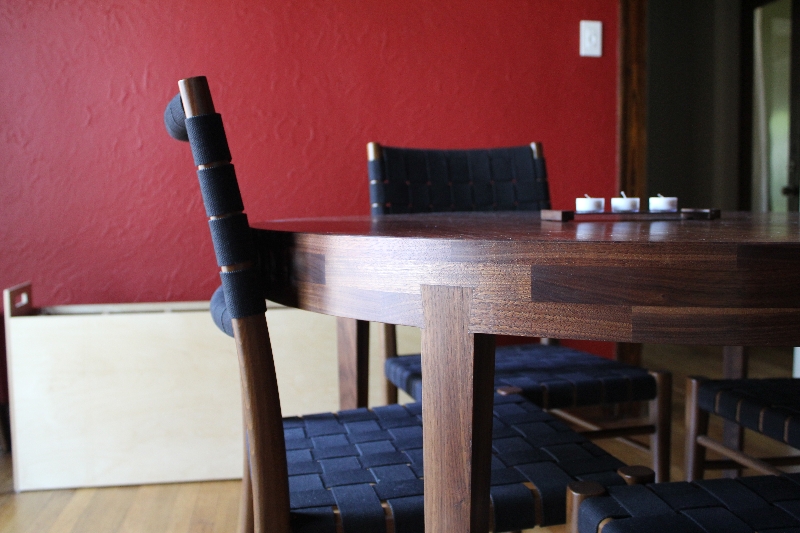
    This client wanted a dining table that would fit into their tight dining area.They love to entertain, so the dining table had to be able to expand to seat more people.The circular dining table is constructed in two halves with sliding aprons that hold two extra leaves. My clients love the danish modern look of sleek and clean but also keeping the depth and character of the wood alive. What we came up with is a design that takes inspiration from Harry Ostergaard. The Johansen table is constructed with stack lamination for the apron with a tapered leg attached by a dovetail joinery.

    [singlepic id=85 w=320 h=240 float=center]

    Traditionally, when building a circular table, craftsmen would stack laminate their aprons out of inferior woods like poplar and then veneer the face of it with beautiful wood like mahogany or rosewood. To me, the different layers and the changing grains of the stack lamination is beautiful in itself, so I decided not to cover it up, but turn it into a design element. We ended up with the dovetail joinery for the legs because it was the most honest connection. Anyone looking at it can visually see that the legs aren’t coming apart.

    [singlepic id=87 w=320 h=240 float=center]

    The table is all constructed out of American Black Walnut except for the Maple sliding rails for the extra leaves. It is finished with a hand rubbed oil finished off with a layer of wax.
    [singlepic id=86 w=320 h=240 float=center]