Tag: austin

  • Constantin Table

    Constantin Table

    Targu Jiu Table

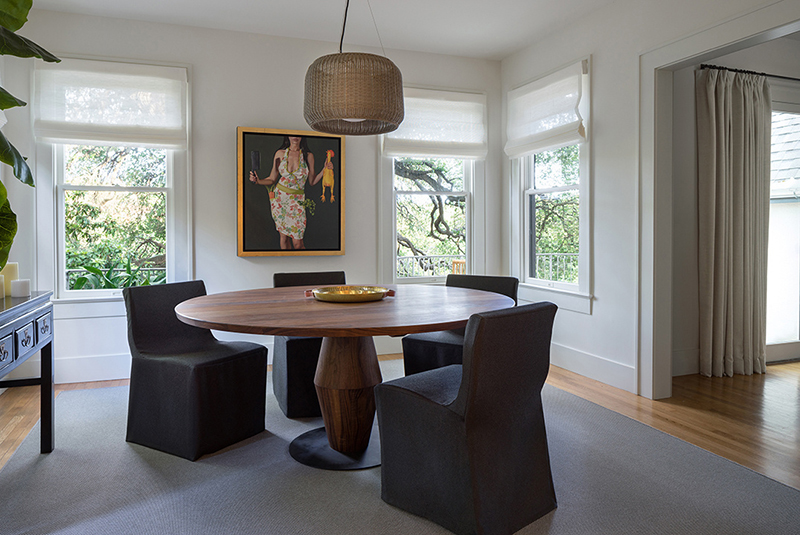
    This project was a collaboration piece with Tim Cuppett Architects here in Austin, Texas. They approached me looking to create an elegant round pedestal table for their client’s home they had been building. They wanted something modern and simple, but with enough details to make it a special central piece for their dining area.

    [singlepic id=279 w= h= float=center]

    We bounced ideas off of each other, and we finally came to this design inspired by Brancusi’s Endless Column in Targu Jiu. There are two tapered cones made with a coopering technique (like the oak barrels for wines and bourbons) that are mirrored and stack on top of each other. Those cones are then sandwiched by two round plate steels that have a long threaded rod connecting the two.

    The table is made out of American Walnut.

    The photography was taken by Whit Preston.

  • Fuller Desk – Rosewood

    Fuller Desk – Rosewood

    fullerdesk1

    This client was referred to me from another client of mine that I had made a game table for. They are long time friends who enjoys playing board games with each other so I was happy to hear that my preferred method of marketing ‘word of mouth’ is still working.

    [singlepic id=274 w= h= float=center]

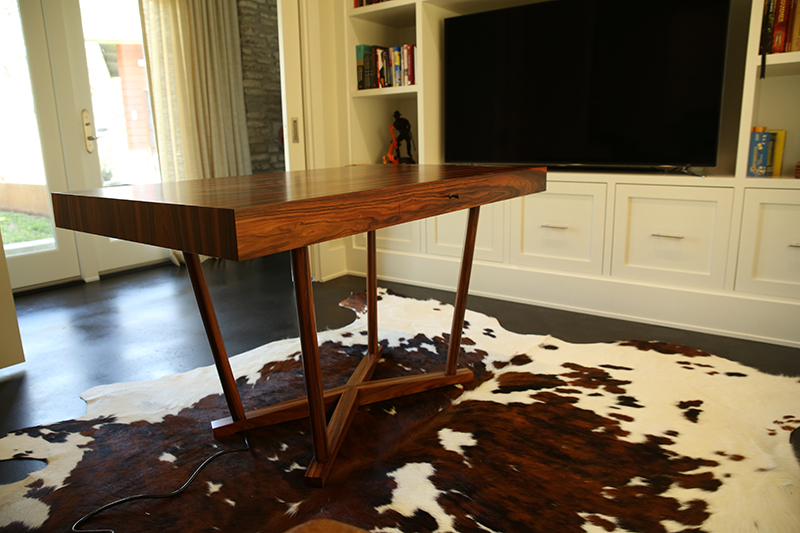
    This client wanted a nice desk for his home office that he could either use as a computer desk or to have a meeting at. He wanted something elegant that looks beautiful in the center of a room. His office is on the small side, so we needed to get the size just right. Too big and it would feel claustrophobic in the room. Too small, and it would look like a child’s desk and wouldn’t be too functional. To make sure we get this right, I made a plywood template to place in the room to make sure it was just right before we finalized the designs.

    [singlepic id=273 w= h= float=center]

    Because the desk is in the center of the room, I wanted my client to be able to freely walk around the desk and not risk kicking the legs of the desk as he walked by. For that reason, I brought the legs in from the corner and tied everything together with low rails. The rails taper up so its wider towards the center. The legs are just straight round since any turned detail would take away from the design instead of adding value. 

    [singlepic id=276 w= h= float=center]

    For the wood, we chose rosewood. Rosewood is a gorgeous wood that has a lot of depth and ages beautifully. The desk top is veneered (because its not a good idea to make a design like this in solid wood due to expansion and contraction) with the grain following from the top down to the sides. The front of the desk flows straight through the drawer front to create one cohesive look. The drawer knob is just a simple design made of bronze. 

    [singlepic id=275 w= h= float=center]

    There is a removable platform to elevate the computer monitor as well as a way to hide wiring. There is one leg that is hollow so a power cord could be snaked up to fuel a small electrical outlet so it’s easy to plug things in and out.

    [singlepic id=277 w= h= float=center]

  • Lounge Chairs

    Lounge Chairs

    lounge2

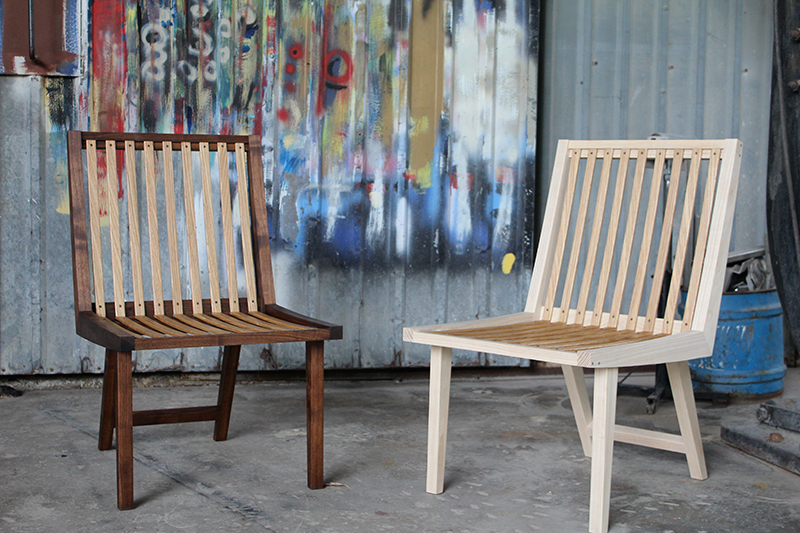
    I’ve always wanted to design and make my own chairs, but have never had the opportunity to do so, so I used the East Austin Studio Tour as a reason to design and make my first chair. Chairs are furniture that is the demands the most from craftsmen. First, it has to be strong enough to withstand all the weight and wracking force of the sitter. Then, it has to comfortable enough for the sitter to sit in for a long time. Then, it has to serve the function of that specific chair. A dining chair should be light and upright so it’s easy to move around and eat from. A lounge chair should be a little lower with more angle so it invites relaxation, but it shouldn’t be hard to get out of. And then finally, it has to look great. Not just from the front and sides, but from all angles.

    [singlepic id=189 w= h= float=center]

    For this chair, I went for unorthodox or different joinery methods so I can experiment and play around. Why make anything speculatively if you don’t push the limits, right? My design focus was for the seat and back to be one unit, and that these curved boomerang shapes will be the focus of the form. I brought the front legs from the sides and attaches to the side with an angled half lap joint with pegs to make it extra sturdy. I also brought the back legs in from the side and created the joinery so that the back legs are visually and physically holding the seat up. The angle of the legs makes the chair joint harder to break but it also keeps the sitter from being able to tilt the whole chair back on just the back legs. The back legs are mortise and tenoned in to the seat with dowels for extra grabbing power.

    [singlepic id=186 w= h= float=center]

    For the seat and back rest supports, I decided to laminate oak into curved slats that mimic the chair sides. The lamination makes it so I can get away with thinner material and makes the chair look nice with or without the upholstery. But just in case one of them does fail, I installed the slats using a dowel that has been hammered to create a mushroom like metal rivets. The wood rivets makes for a nice visual as well as tactile experience. I think the slats also make the piece look Nakashima-esque, but I may just be flattering myself.

    [singlepic id=185 w= h= float=center]

    You can’t have a lounge chair without cushions, so I commissioned my quilting and sewing friend Shannon Harris, to design and create the cushions to that would go well with the chairs. She came up with a simple and modern upholstery design using hexagons that compliments the lounge chairs well. I think the unique design fits in with the unique design of the chair perfectly. There is also a feeling of masculine and feminine to the chairs and upholstery by the wood and colors chosen. Also, for the show I asked Shannon to design a quilt that we could drape over the back of the chairs to create another layer. I also think it brings a feeling of warmth and that the furniture is ‘lived in’. The quilt is beautiful! the hexagon pattern flows from one corner to the other with changing tones. It speaks to the modern aesthetic while bringing warmth- which a lot of modern designs are lacking in.

    [singlepic id=215 w= h= float=center]

  • Outdoor Tables + Benches

    Outdoor Tables + Benches

    bergoutdoor1

    My clients have a backyard garden area that would be the envy to anyone. The landscape architect designed an elegant area where people can hang out and socialize next to freshly growing vegetables, with the smell of smoke and cooking from the grill, and enjoying good company under an arbor with fruitless bradford pear trees

    [singlepic id=152 w=320 h=240 float=center]

    The arbor  was started a few years ago and is just now getting to be filled out so my clients wanted to get a nice outdoor table to dine under. They wanted something classy that blends in with the landscape, but without being too rustic. They have a few stone sculptures that reminded me of a Tuscan winery so I started looking for inspiration in books, but all I could see were weathered and beaten up gray farm style tables. That weathered look is nice, but I didn’t think it would look good in their backyard. I also think people should grow up with their furniture and see it weather themselves through the years instead of getting furniture already weathered- their history unknown.

    [singlepic id=150 w=320 h=240 float=center]

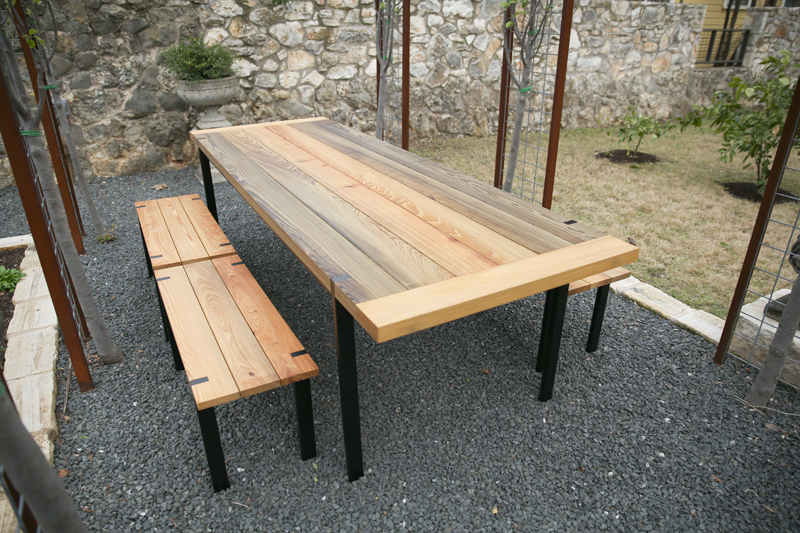
    I took inspiration from the arched arbors. At first I wanted to incorporate arches into the design but decided that it was too obvious and predictable so I took the same elements from the supports that hold up the arches. The archway supports were made from 1″x2″ rectangular tubing, so that became my choice of material. When you step away from under the archway, the 1×2 lines going vertical becomes a strong element so I wanted to emphasize that vertical line. To do that, I let the legs shoot straight through the top so it’s visible from all around. This cohesion actually makes the two different material distinct in my opinion. In a lot of the metal and wood furniture on the market out there, the difference of metal and wood becomes kind of lost. Usually, the wood just sits on top or is let into a metal frame.

    [singlepic id=154 w=320 h=240 float=center]

    Now, the question was the wood. I was looking at using cypress, but on my drive to meet my metal worker in Elgin, I saw a sign on the side of the road ‘Sinker Cypress’. Sinker Cypress is logs that have been submerged underwater for decades and sometimes centuries. The logging industries used to float logs down the river as a means of transportation to the milling factories, but sometimes the logs sink underwater and was forgotten until recently. Recently, loggers have found these old cypress logs that have been preserved underwater due to the lack of oxygen. Sinker cypress has beautiful colors ranging from olive to gold. To read more about it, visit here.

    [singlepic id=157 w=320 h=240 float=center]

    One thing I don’t like about picnic tables is that the ends of the boards start moving and becomes misaligned. To help with this issue, I decided to add a breadboard on the ends. This breadboard will keep the many boards aligned and also helps to cover up the endgrains (end of the board) since endgrain is like a straw- it sucks up the moisture. To help shed water, the boards have 1/8″ gap between the boards. The sinker cypress is finished using Penofin, which is a type of outdoor oil designed for decking and siding. It’s not the most durable finish out there, but it’s easy to fix and maintain.

    [singlepic id=153 w=320 h=240 float=center]
  • Outdoor Bench with Sliding Table

    Outdoor Bench with Sliding Table

    berbench2

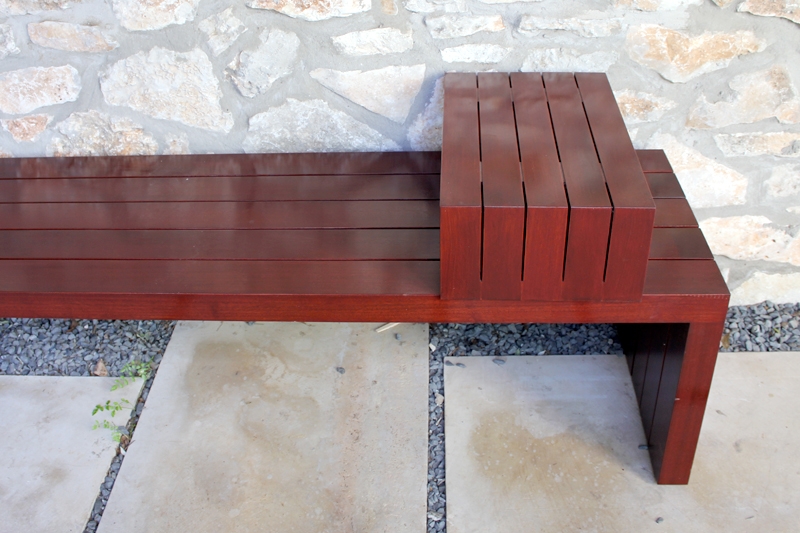
    This outdoor bench was made to fit against a stone wall at my client’s backyard garden. We wanted to highlight the stone wall since it was one of the key features that tied the whole backyard together. We decided to use clean, simple, lines to design the bench. The bench uses 2 1/2″ thick boards of mahogany since it needs to span 8 feet, but it also gives the bench a visual weight that helps to make the simple lines bold. The stone wall can be used as a back rest. The use of natural materials used in this raw way is appealing to me. There’s little frou frou and the heaviness of each of the materials fits with the concept of the outdoor space.

    [singlepic id=91 w=320 h=240 float=center]

    [singlepic id=92 w=320 h=240 float=center]

    The garden backyard was designed not only as a garden, but also as a social place where guests can enjoy each other’s company outdoors as many people here in Austin love to do. With that in mind, we designed the bench with a table that slide along the length of the bench. This sliding table serves not only to hold guest’s drinks or plates, but it also gives more flexibility to different kinds of guests. If there’s a couple that want to sit next to each other, then move the table over. If you just want to sit with a friend for a chat, then you can also share the table by sliding it in between. Maybe someone is telling a story and everyone wants to sit on the bench, then you can roll the table off to squeeze another person in.

    [singlepic id=93 w=320 h=240 float=center]

    [singlepic id=90 w=320 h=240 float=center]

    The bench is finished using Sikkens Cetol 1+23 system.

    [singlepic id=94 w=320 h=240 float=center]