
The good people of Far West Capital are so awesome that their business and staff just keeps getting bigger and bigger. I had made a 12′ conference table for them a few years ago, and they’ve already outgrown that one, so they commissioned me to make a 18′ conference table this time. They loved the traditional meets modern aesthetic of the last one, so we decided to design something that looks totally different from the last one, yet feels similar.
[singlepic id=162 w=320 h=240 float=center]
This was by far the biggest project I’ve had the opportunity to work on and logistics became the first and foremost in the design aspect. How can I make these parts in my shop and how can I break the pieces up so I can move it safely and easily? I decided that the top will be made from 3 parts and I wanted to make the top as light as possible since that has the biggest area. To support the top, there are thick and wide aprons that come apart and fit together with notches made in the wood. This gives stability to an otherwise flexible top. The aprons rest on pedestals that are angles and tapered in almost every direction. The taper came from trying to gain as much foot space as possible without sacrificing stability. One side of the pedestal is held in with clips so you can remove it to store and hide conference table equipment. At the feet there is a 1/4″ blackened plate steel that adds weight and distributes the footprint out so the top wont tip over.
[singlepic id=145 w=320 h=240 float=center]
The whole table is made from peruvian walnut veneered panels with solid wood edging. The removable center piece is made of spalted beech. Spalted is a figure in wood caused by fungal attack. The wood is left for fungus to attack, but then harvested before the wood rots completely and becomes unusable. It’s characteristics are black vein like lines with wood tones around it being different. I think the spalted beech was a nice compliment to the peruvian walnut and adds a little bit of country to the otherwise sophisticated elements.
[singlepic id=147 w=320 h=240 float=center]
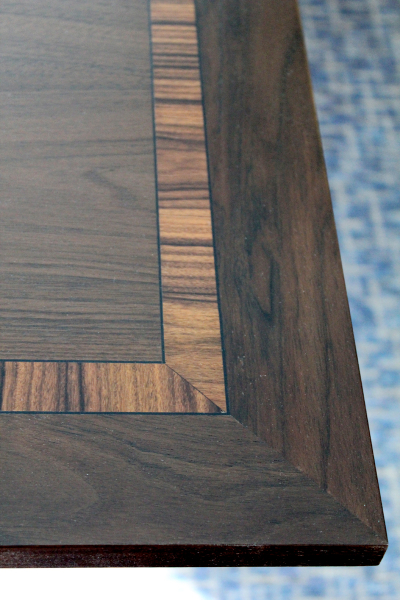
To break up the large dark surface and to give a nod to traditional furniture we chose to inlay cross banding around the border. Cross banding is inlayed wood that is aligned so the grain is oriented side to side across the length. The outer cross banding is made from Bolivian rosewood and the inner cross banding that borders the spalted beech is Macassar Ebony. I feel the different tones in the woods give a nice transition to the different woods.
[singlepic id=144 w=320 h=240 float=center]
Sixteen people can sit all around the table easily and maybe a few more if people are willing to get close and cozy with each other. I think this design is a success because the real design elements are in the small details.