Tag: Handle

  • Bi-Fold Credenza

    Bi-Fold Credenza

    malinacred5

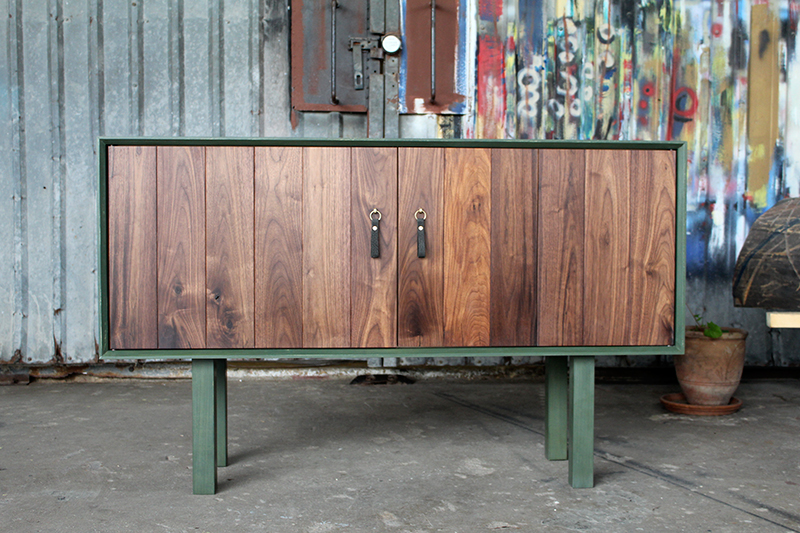
    This credenza came about from one of my past clients wanting a cabinet for storing and serving snacks when he has clients over. He wanted something simple that works with the rest of the furniture and decor in the room, but a design that can stand by itself also.

    [singlepic id=225 w= h= float=center]

    I wanted to focus on how the cabinet is used and engaged- first and foremost. I love an element of suprise when you open a door or drawer so I wanted a dark exterior and a light interior. The lightness also helps to show the contents of the cabinet in a better light. I started thinking about how the light interior is revealed to the user and wanted something theatrical. We went for a bi-fold door that reveals the contents a little at a time- like the curtains before a play is about to start. Each board of the walnut has a bevel on the edge so it creates a texture in regular intervals and makes the door read like many different boards rather than just two doors.

    [singlepic id=229 w= h= float=center]

    Most of the furniture in that room is walnut, so we chose solid walnut for the doors, but we didn’t want the walnut element to be too over powering so we decided on a painted exterior. We went for a forest green milk paint. we chose milk paint because it’s durable and wont chip off, but mostly because I’m interested in the idea of imperfections. It’s nearly impossible to get a perfectly consistent and flat paint job with milk paint as you get with spray paint or with using regular paint. But unlike regular paint where inconsistency is distracting, the slight difference in tones that milk paint brings enhances it and gives the piece a handcrafted element.

    [singlepic id=227 w= h= float=center]

    For the handles, I used a leather key chain made by an artist in London using nubuck leather and attached it to a brass tab that I custom made. The result is a soft tactile handle that is free moving so you can control the direction of the pull.

    [singlepic id=226 w= h= float=center]
  • Tambour sideboard

    Tambour sideboard

    sideboard9

    I was approached to design a credenza/sideboard that matches a conference table I made in the past. A+L Conference Table. The main purpose for the sideboard was a storage unit that housed all their conferencing equipment when they weren’t using it as well as all the wires and misc things that should be hidden when it’s not used. The sideboard also makes a great platform to showcase all the awards they have won in the past.

    [singlepic id=124 w=320 h=240 float=center]

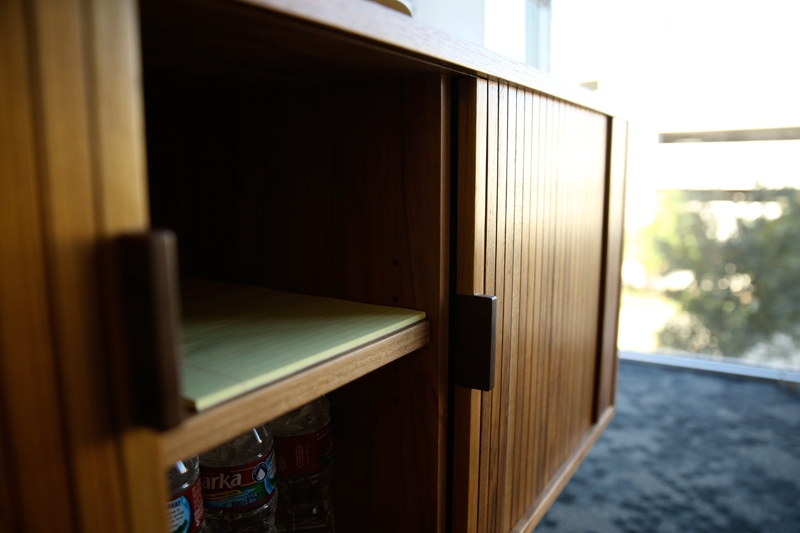
    Since there wasn’t a whole lot of space between the wall and the conference table chairs, I wanted to avoid having a door that swings out- especially if they needed the cabinet open for one reason or another. That left me with sliding doors or tambour doors as the options for the doors. Tambours are doors that slide in a track and roll so that it’s able to tuck into the sides and hide behind the back panel. You see this used on roll top desks.

    [singlepic id=127 w=320 h=240 float=center]

    After our design meeting, the client and I both agreed that tambours were the better choice for this situation. Not only does it look nicer, it’s a better solution functionally since you can reveal just the center shelf area, or open it all the way to showcase the whole interior of the cabinet. I also believe tambours have a certain nostalgic feeling that reminds us of beautiful furniture of the past.

    [singlepic id=130 w=320 h=240 float=center]

    The design inspiration came from mid-century modern furniture. I think the simplicity in form of the designers of this era got it just right. It’s hard to improve upon it, so I left the lines as clean as possible and tried to let all the details shine. Like many of SYD furniture, the eye is in the detail and the craftsmanship. Spend time on those elements and you don’t need fancy or unusual forms to stand out.

    [singlepic id=125 w=320 h=240 float=center]

    Most of the furniture in the room is made of pecan, so pecan was the natural choice of wood for this project. We didn’t want the room to look like a forest of pecan, so we decided to make the tambour doors out of a different, but complimentary wood. In this case, we decided on teak. The warm color of teak and the rich grain makes the door the focal point without taking all of the spotlight.

    [singlepic id=129 w=320 h=240 float=center]