Tag: Mahogany

  • Blaine desk & credenza

    Blaine desk & credenza

    blaine4

    [singlepic id=259 w= h= float=center]

    This client was re-doing his entire office and wanted something simple but nice for his office. We worked out a design for a matching set of furniture that was simple in form, but rich in details. 

    [singlepic id=264 w= h= float=center]

    There’s two parts to each of the designs. The first part is the outside dark layer. The dark layer is mahogany that has been stained to be a dark rich tone. The top flows down into the top, creating a continuous line. The legs end on the floor with a cap to create a visual punctuation mark.

    [singlepic id=265 w= h= float=center]

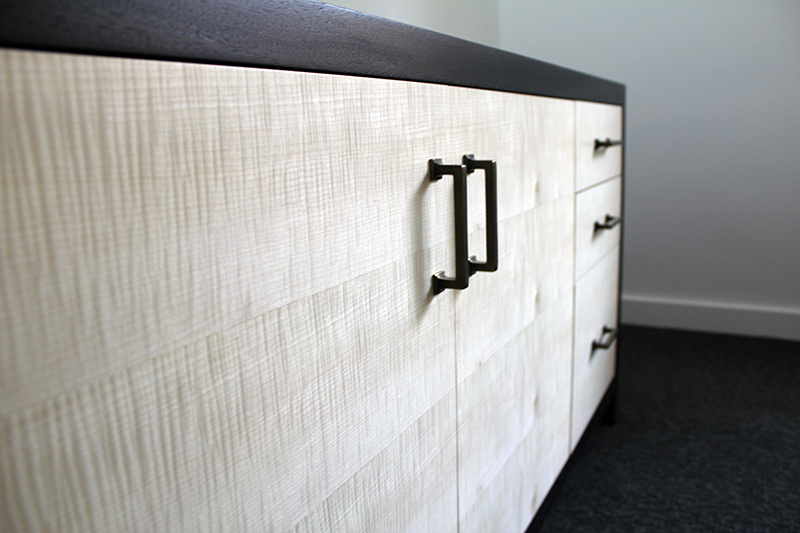
    The second part is the inner part and that is made from veneered panels of rippled sycamore. The photos don’t give this wood justice, but the wood grain shimmers as you walk around the piece as it catches different light source. To break up the spaces for the drawers, I inlayed a line of wenge. 

    [singlepic id=263 w= h= float=center]

    The hardware was picked out by my client and has a nice blend of traditional and modern element. It’s a nice visual stamp that breaks up the big vast white space and gives your eye something to follow.

    [singlepic id=261 w= h= float=center]
  • Barrister inspired File Cabinet

    Barrister inspired File Cabinet

    filecabe4

    My client wanted a file cabinet to go with the round meeting table I had made for his office. Not needing to store many files, I wanted a piece of furniture that has many functions. Along with being a file cabinet, I wanted a to create a little shelf to place books, artwork, or other things in. Taking a cue from a barrister’s bookcase, I decided to make two separate cabinets that is stacked on top to create a bigger cabinet. This idea solidifies the different function these two cabinets have but combines it in one unified piece. I also made the total height end up so that it becomes a little table surface to put keys, snacks, business cards, or cups on.

    [singlepic id=182 w= h= float=none]

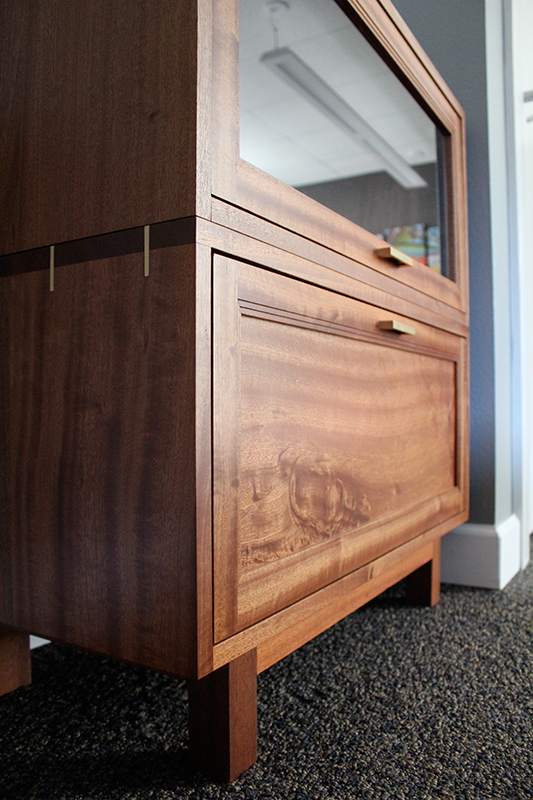
    First, I created a wide drawer for all the hanging files and oriented them in a lateral orientation to maximize the amount of storage without the cabinet becoming too deep. I didn’t want just a regular plain old box so I decided to have the top poke through so you see the end grain from the side. I also put in brass splines to accent that joint, but also give a little jazz to an otherwise boring joinery.

    [singlepic id=180 w= h= float=left]

    The upped cabinet is created in a similar fashion but the door is a glass door with mahogany frame. The idea for doors in a barrister’s bookcase is that the glass protects the contents from dust, without blocking the view of the contents. I wanted the door to swing up and slide back so no one has to hold the door open to access the contents. The mechanism took some figuring out to do since the door wants to rack and pinch as it’s sliding back. I alleviated some of that tendency by creating a brass guide that runs in a slot created in the back side of the door. The track helps keep the doors aligned parallel.

    [singlepic id=183 w= h= float=left]

    The whole piece is created using solid Sipo Mahogany. The drawers are made from Hard Maple with a box joint joinery.

  • Sapele Round Table

    Sapele Round Table

    harmonsonround1

    This table was commissioned to be a meeting table for guests and clients at my client’s office. I had previously created other furniture for his office in a style that mixes traditional details and arranged in a modern way – Harmonson Desk & Harmonson Credenza. I wanted to keep those same ideas with this round table, so I worked on blending the traditional elements with modern elements without one being over bearing.

    [singlepic id=179 w=320 h=240 float=center]

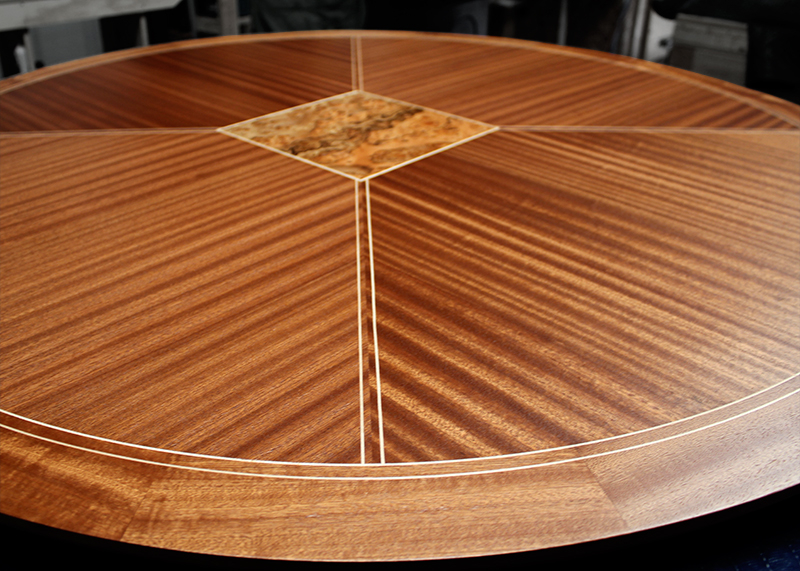
    The top is a beautiful 1/16″ thick ribbon striped sapele veneered top. The perimeter of the top is made out of solid wood not only for looks, but for protection. I arranged the sapele veneers in quarter section so that each quarter lines up to meet in the center. This pattern creates a V- pattern where each sections meet. Since I was able to get a nice consistent line, I didn’t want to hide it so I decided that instead of doing a single inlayed line, I would do a double line and have the V-pattern become another focal point. Having that double line also meant that the lines need to terminate to the perimeter in a thoughtful and graceful way so I decided on another double line that follows the curve of the top.

    [singlepic id=177 w=320 h=240 float=center]

    To keep the modern element, I decided on a tapered square pedestal base. The sapele is used again for the panels, which sticks out 3/16″ to create a three dimensional element. The framework is blackened hard maple. A lot of the design elements of this round table is actually based on a square- the tapered pedestal base and the top being broken into quarters- so I wanted to follow that theme and create a square centerpiece with a decorative wood (pepperwood burl). I think the square ties the top and the base together.

    [singlepic id=178 w=320 h=240 float=center]

    The square is oriented so it looks like a diamond with the double maple inlay stringing terminating at each of the corners. I’m very happy with the combination of sapele and pepperwood burl together. The tones compliment each other and the straight lines of sapele counter-act the free form wazy grain of the pepperwood burl.

    [singlepic id=176 w=320 h=240 float=center]

  • Stefanie Desk

    Stefanie Desk

    stephdeskThis client approached me wanting to create a desk for her fiance as a surprise christmas present. She liked the Harmonson desk I created earlier, and she also showed me several photos of a contemporary and minimalist design she liked. I took the common link between the two and came up with this design.
    [singlepic id=117 w=320 h=240 float=center]

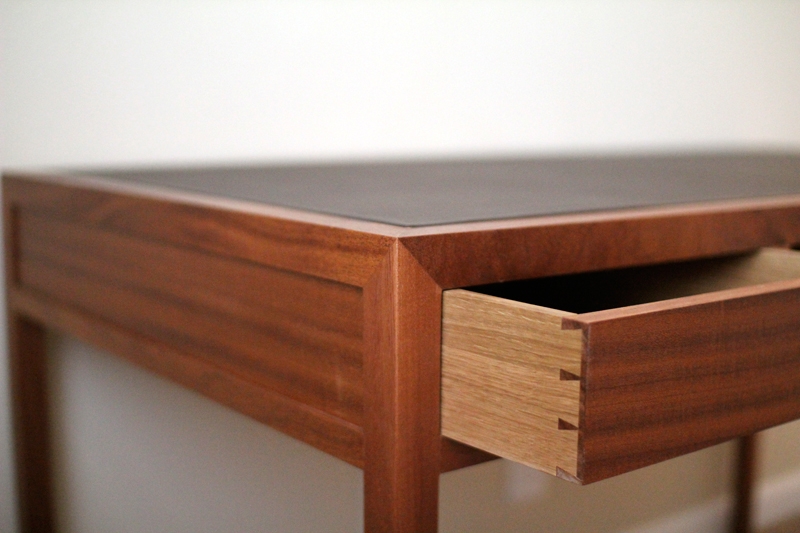
    This design is based off of the popular parson’s table. The minimal and clean look, I believe, is a timeless look. Where the legs meet the top, I decided to use a triple miter joinery. Most parson’s table made nowadays is mitered at the top, but the legs just butt up to the top, creating a weak joint. The triple miter, which was used extensively in chinese furniture, is a locking joinery. There are small tenons that lock into the mating surface, creating a joinery that is strong enough to stand even without glue- though glue is still used to make the joint even stronger.

    [singlepic id=118 w=320 h=240 float=center]

    The drawers are made from quartersawn white oak (which is stable and wear resistant) with hand cut dovetail joinery that ride on maple drawer guides (also wear resistant). I’m a big fan of drawers that slide against wood if it’s made and fitted well. It’s a subtle thing, but wood on wood drawers feel and sound better when used.

    [singlepic id=116 w=320 h=240 float=center]

    Other than the top and the drawers, the desk is made from Sipo Mahogany and Sapele panels . I used leather for the top because the client wanted the top to be made of another material and leather seemed very appropriate for this design. The leather helps to emphasize the frame work in the desk as well as making a nice writing surface. The dark tone of the leather will tie together nicely with the dark rubbed bronze of the handles manufactured by Linnea. (these photos don’t show the handles because I did not have the handles at the time of the photos. I will update with more photos when I take more photos.)

  • Outdoor Bench with Sliding Table

    Outdoor Bench with Sliding Table

    berbench2

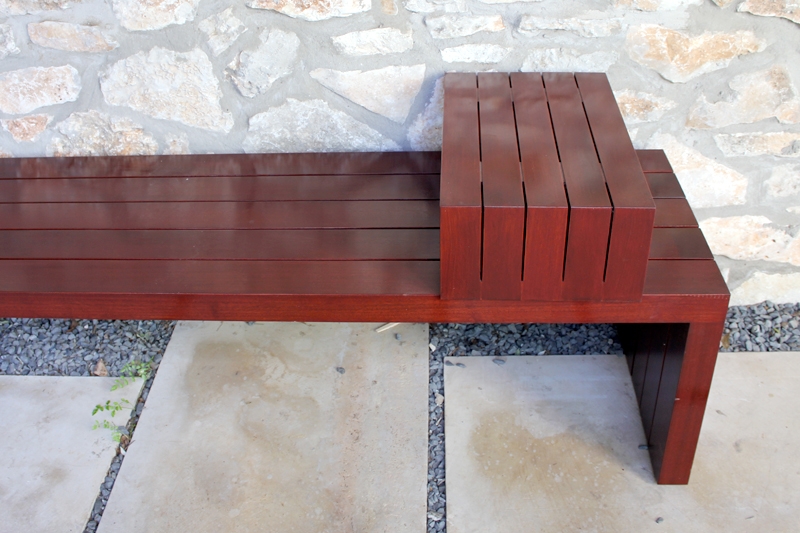
    This outdoor bench was made to fit against a stone wall at my client’s backyard garden. We wanted to highlight the stone wall since it was one of the key features that tied the whole backyard together. We decided to use clean, simple, lines to design the bench. The bench uses 2 1/2″ thick boards of mahogany since it needs to span 8 feet, but it also gives the bench a visual weight that helps to make the simple lines bold. The stone wall can be used as a back rest. The use of natural materials used in this raw way is appealing to me. There’s little frou frou and the heaviness of each of the materials fits with the concept of the outdoor space.

    [singlepic id=91 w=320 h=240 float=center]

    [singlepic id=92 w=320 h=240 float=center]

    The garden backyard was designed not only as a garden, but also as a social place where guests can enjoy each other’s company outdoors as many people here in Austin love to do. With that in mind, we designed the bench with a table that slide along the length of the bench. This sliding table serves not only to hold guest’s drinks or plates, but it also gives more flexibility to different kinds of guests. If there’s a couple that want to sit next to each other, then move the table over. If you just want to sit with a friend for a chat, then you can also share the table by sliding it in between. Maybe someone is telling a story and everyone wants to sit on the bench, then you can roll the table off to squeeze another person in.

    [singlepic id=93 w=320 h=240 float=center]

    [singlepic id=90 w=320 h=240 float=center]

    The bench is finished using Sikkens Cetol 1+23 system.

    [singlepic id=94 w=320 h=240 float=center]