Tag: Media

  • Welder Console

    Welder Console

    tvconsole1

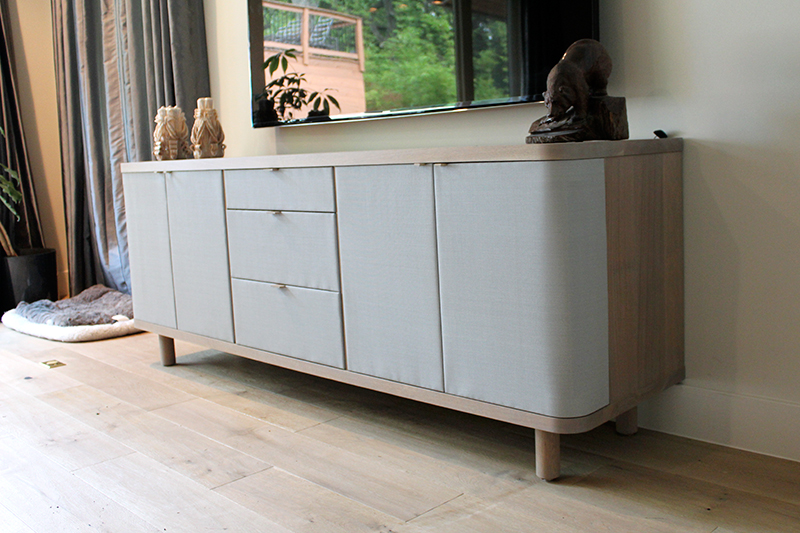
    My clients had been looking for years for a tv console to store all their media equipment in an elegant way. After countless frustrating hours and days of shopping online and going to other retail stores and not finding anything that would work for them, they were recommended to me by a mutual friend. Before they met me, they had no idea that people can get furniture made exactly the way they wanted to the dimensions that they needed it made to.

    [singlepic id=234 w= h= float=center]

    What they were looking for was fundamentally simple but the lack of customization that most retail furniture businesses offer made it difficult for them to find what they wanted. All they wanted was for their equipment to be hidden, have easy access to them when they need to switch out to new equipment as technology keeps changing , and for the speakers to be hidden. All of this while looking beautiful and built to last for generations.

    [singlepic id=235 w= h= float=center]

    After talking through them about the functional requirements for the piece, we started playing around with how it should look. They didn’t want anything that stands out too much and wanted it to blend in with the room. For the speakers to work inside the cabinet, we needed something that would let air flow through without disrupting sound. Also, since it’s a 4 speaker system, we needed to be able to space the speakers apart so the whole front side had to be wrapped in speaker cloth. The cloth also helped with ventilation problems that many media cabinets have. We decided on some nice speaker cloth made by accoustone and sold by accoustical solutions. They are professional grade speaker cloths with many different colors and textures to choose from. We took a functional requirement and turned it into a visual design feature.

    [singlepic id=238 w= h= float=center]

    The annoying part with any media cabinet is changing or wiring up new equipment. You have to reach in the back to a whole mess of cords and somehow finagle them through a small hole cut in the back of the cabinet. To make life easier, I made the back on this console removable in sections without any tools. Each section has a wide slot cut on the edge so no cords are ever trapped inside a hole. We left some gap between the wall and the back panel so that cords have some space to be wrapped up so it’s not just dangling down.

    [singlepic id=247 w= h= float=center]

    There are four doors on both ends- the furthest doors having a big radius on the corners. Bringing the speaker cloth around the corner like that lets the sounds escape in a much bigger area then if it was closed up the the sides. It also softens the credenza and keeps it from being too minimal and hard edged. The center bay has a drawer for remotes and other accessories at the top, a drawer that houses a center speaker, and the bottom part has a pull out tray that houses the receiver.

    [singlepic id=237 w= h= float=center]

    An unexpected feature that we didn’t think about with the speaker cloth is that when the lights are low, a diffused light from the receivers and equipment can be seen playing across the surface.
  • Caswell Media Cabinet

    Caswell Media Cabinet

    caswell-media-1

    My clients approached me at a studio tour after seeing some of my works on display. They have been looking for a designer to come up with a solution to their music equipment storage needs. The husband is a music lover with music being a huge part of his life. His wife wanted something that covers up all of his equipment in an elegant and charming way. They came to me after being disappointed with other designers who couldn’t think outside the box- literally. One of the first things they told me was that it should have some curves and it should fit in with the rest of their house with all the art they have collected from years of going on trips.

    [singlepic id=171 w=320 h=240 float=center]

    The cabinet bows out in the middle creating a soft curve in the front. The solid wood doors follow that curve and have a slight concave surface. The concave curve is subtle enough that it’s not immediately obvious what’s going on. It’s only after you walk around and see the light wrapping and bouncing off the surface that you notice something is going on. Upon closer investigation, you notice the curves outlined on the bottom of the cabinet like gentle waves.

    [singlepic id=172 w=320 h=240 float=center]

    It’s a subtle thing, but the boards in the center are slightly narrower and the boards wider towards the outside so that as the curve stretches back, the boards look similar in scale to the others. To get a nice crisp line where the random sized boards meet, but keep the same depth of curve on the surface of the doors, I created a hand plane with a radius on the blade and sole so I can fine tune everything so it’s just right. The idea of doing things by hand appeals to me since people can subconsciously pick up on small irregularities that machines (robots) can’t reproduce- creating a warmer and friendlier piece.

    [singlepic id=173 w=320 h=240 float=center]

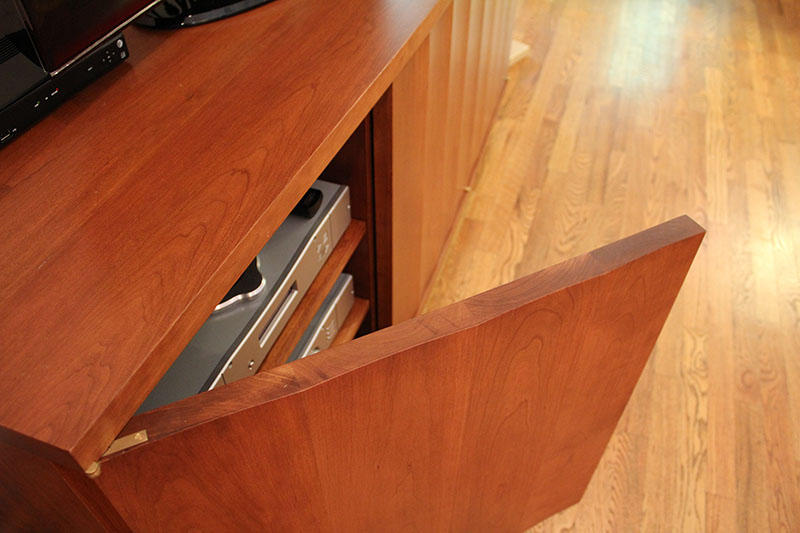
    The doors are hung using offset knife hinges. These discreet hinges don’t break up the clean lines but offer the ability to swing the to almost 180 degrees (or 270 degrees on the sides). Since any knobs or pulls would also break up the clean lines, we opted to go for the magnetic push latch handles. Just press on the door and pop, the door opens enough to get your hand behind the door.

    [singlepic id=170 w=320 h=240 float=center]

    The shelves are all adjustable and also follow the same convex curve as the cabinet front so everything is integral inside and out. The feet also has a gentle tapering curve to create unity but most importantly, the feet give the whole piece a human or animalistic feel. (not square and sharp like many modern furntiures out there).

    [singlepic id=169 w=320 h=240 float=center]

    I had my go-to finisher, Ken Boone, do some color matching to darken the cherry up a little bit, and then topped off with a lacquer finish. I delivered the media cabinet to a very happy client. – “Every time I walk in this room, I just take a long look at it and smile”

  • Yuta Standing Desk

    Yuta Standing Desk

    a3d88286a8c411e38fd8126050b2ecd3_8

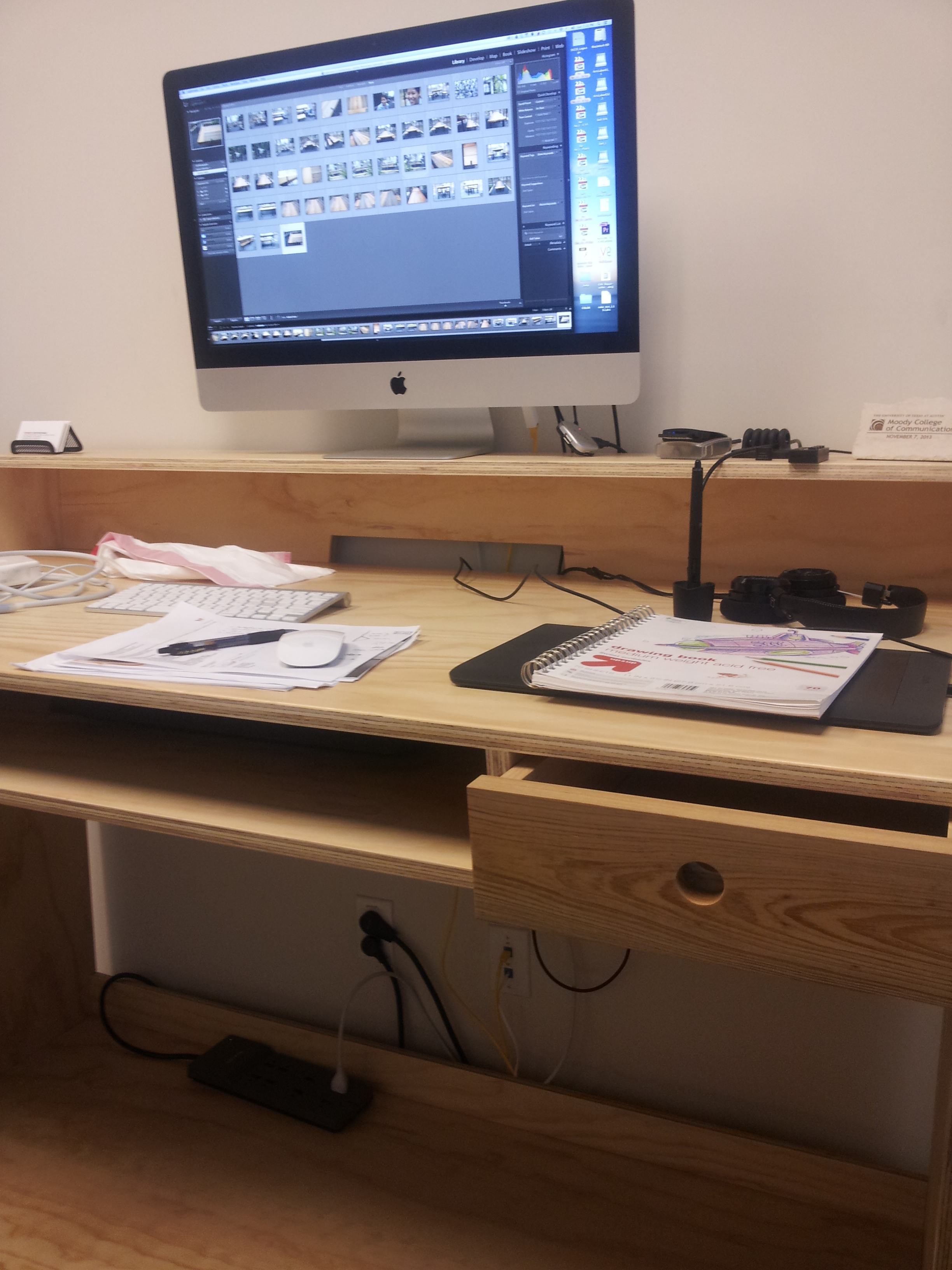
    My brother, Yuta, commissioned a standing desk from me for his office. He’s been wanting one for awhile and had an Ikea one for his home office. He complained that it wasn’t sturdy and would wobble every time he touched it. I had also created a standing desk speculatively earlier, so I had him check it out so we can nail the dimensions down. The thing with standing desks is that there is not a standard size like most other furniture because we’re all different heights with different arm lengths and etc, etc.

    [singlepic id=164 w=320 h=240 float=center]

    Since he works for a media production company, he had to have plenty of space to sprawl out papers or editing equipment as well as his big computer monitor. I set about creating different levels of surfaces- one for his monitor, shallow and higher up so the eyes are level with the monitor. I created another level under the main surface so he can quickly clean the worktop and added drawers for extra storage. There is also a shelf towards the bottom where he can rest his feet on, store more things, and also to act as a stabilizing rail.

    [singlepic id=166 w=320 h=240 float=center]

    The difficult part of designing this piece was balancing out the size and bulk of the piece. The top came out to be 30″ wide x 58″ long. I started by cutting away angles- a large one in the front and a subtle one in the back. The desk had to match the rest of the room’s existing furniture (another desk I made for his birthday earlier) so we decided on pine plywood with the edges exposed. I kept going back and forth on this with myself, but I’m glad I stuck with it because the tone, color, and the grain is elegant. I’m especially happy with it because it uses an affordable material and shines it up with the use of thoughtful design and good craftsmanship.

    [singlepic id=167 w=320 h=240 float=center]

    To keep the light color, I used water-based polycrylic. The drawers are made from ash with the drawer front made from sinker cypress. I used UHMW plastic to act as drawer runners so the drawers won’t run a groove into the desk from use over time.

    [singlepic id=168 w=320 h=240 float=center]