Tag: modern

  • Carter Table

    Carter Table

    carter5
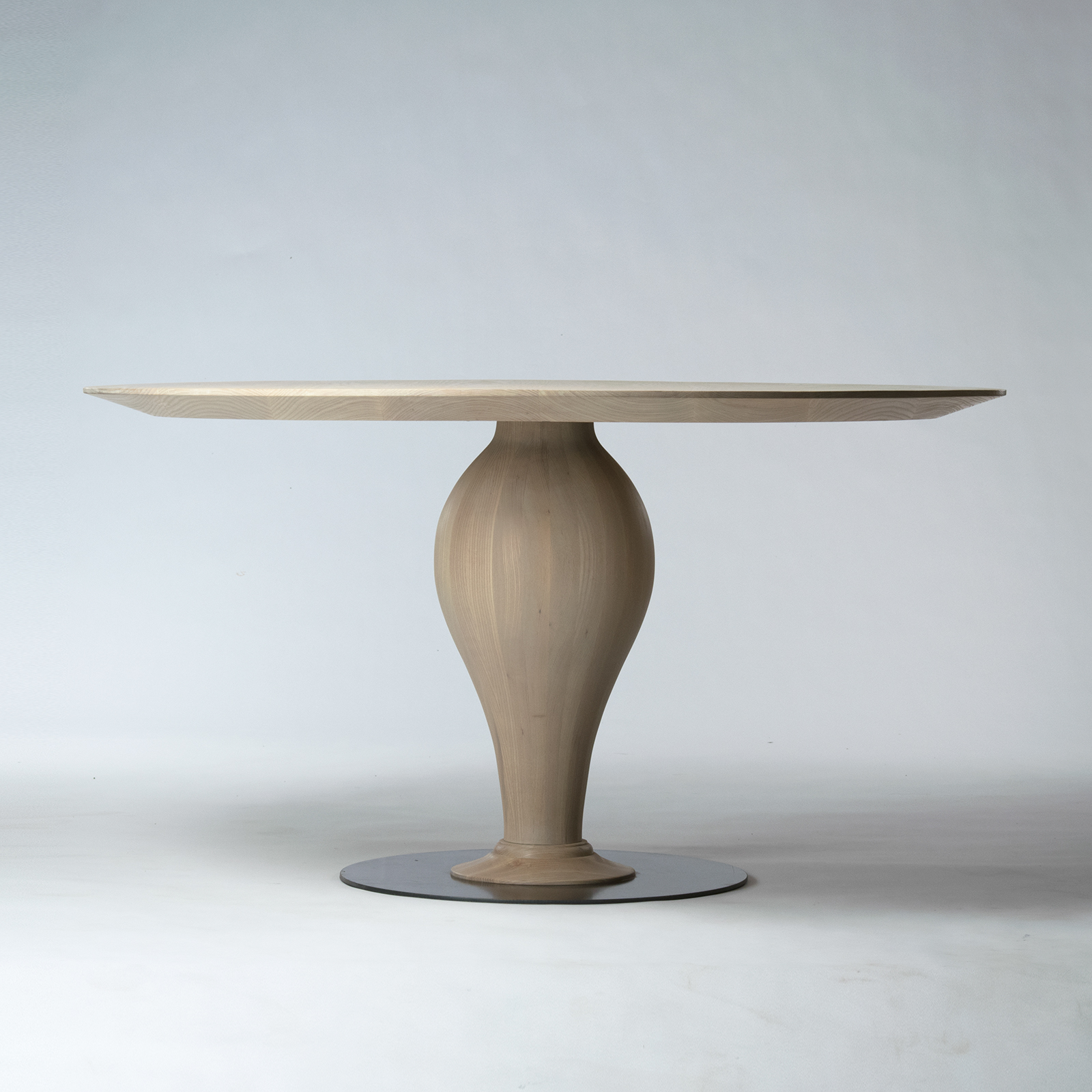
    Tim Cuppett Architects approached me with creating this table for a hill-country retreat they were creating for their client. The design process came about as a collaboration with them.

    They needed a kitchen table for everyday use that’s separate from the big dining room table. This would be the table they would use the most often for daily use- casual eating, conversations, homework, coffee drinking, etc. In other words, it had to be made to withstand the daily toil, but still be elegant. Space was limited, so the round table was a natural choice.

    [singlepic id=301 w= h= float=center]

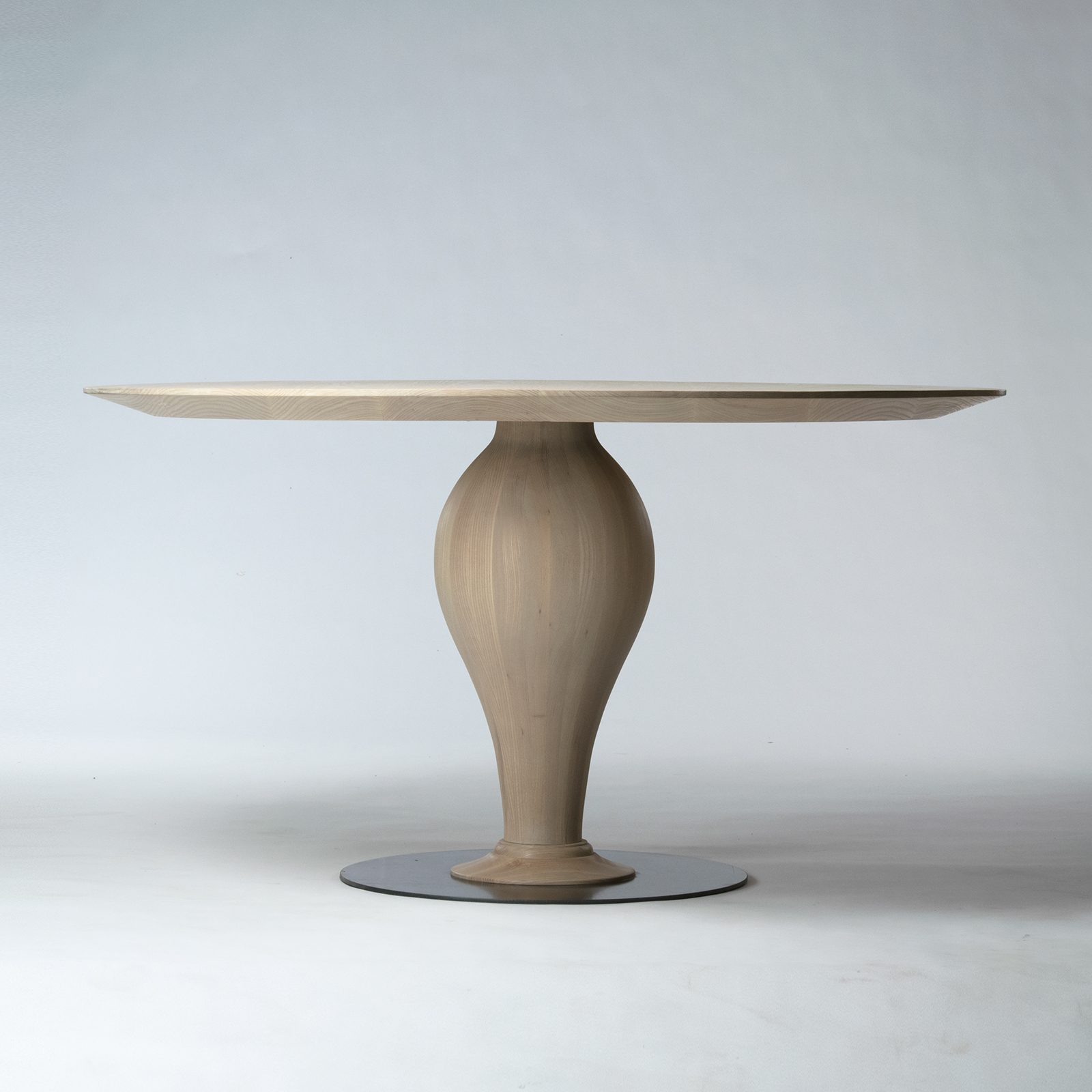
    The design was driven from the chair backs of the client’s family heirloom dining chairs. The chair had a queen anne style back, so we took that form and transformed it into the pedestal base. Because we didn’t want to see wood lamination joint lines as we cut the extreme curves, we glued up the base in a coopering technique. The ash wood was selected to get the straightest grain possible to keep the lines flowing smoothly.

    [singlepic id=299 w= h= float=center]

    The top is actually a thick top, but we cut a large bevel around the perimeter to create a knife edge to keep the top visually light. It also allows for more view of the pedestal base. There is a metal framework inlayed into the underside of the top to keep everything flat and allows for a strong connection to the base.

    [singlepic id=300 w= h= float=center]

    For a narrow pedestal base like this, the footing is always an issue. Most traditional pedestal bases have a large wooden structure (usually in a claw foot detail) that would have destroyed the whole look, so we went for a much cleaner and more modern look by adding a steel plate as the feet. Creating a thin profile for the bottom really highlights the shape of the pedestal without sacrificing structural integrity or making a tipsy table.

    [singlepic id=302 w= h= float=center]

    The table was finished in white oil that kept the wood looking as natural as possible.
  • Constantin Table

    Constantin Table

    Targu Jiu Table

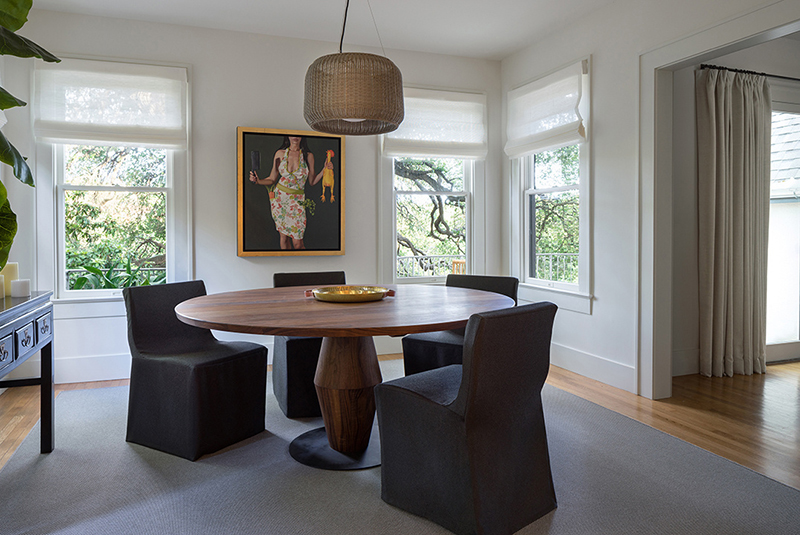
    This project was a collaboration piece with Tim Cuppett Architects here in Austin, Texas. They approached me looking to create an elegant round pedestal table for their client’s home they had been building. They wanted something modern and simple, but with enough details to make it a special central piece for their dining area.

    [singlepic id=279 w= h= float=center]

    We bounced ideas off of each other, and we finally came to this design inspired by Brancusi’s Endless Column in Targu Jiu. There are two tapered cones made with a coopering technique (like the oak barrels for wines and bourbons) that are mirrored and stack on top of each other. Those cones are then sandwiched by two round plate steels that have a long threaded rod connecting the two.

    The table is made out of American Walnut.

    The photography was taken by Whit Preston.

  • Father and Sons’ Desks

    Father and Sons’ Desks

    desks2

    My client approached me wanting to create a set of desks for himself and his two sons. They would be using the same office room so they could work together in the same space. My client wanted the piece of furniture to be heirloom quality so the boys can take the desks with them when they graduate college.

    [singlepic id=254 w= h= float=center]

    The father wanted a timeless design with some traditional elements, and the boys (of course) were looking for something more modern in design. I took both elements and went for a nice federal style piece. There’s enough detail and handcraft aspects to make this a timeless heirloom piece, but refined enough to keep it from being mistaken as just an old antique period piece.

    [singlepic id=256 w= h= float=center]

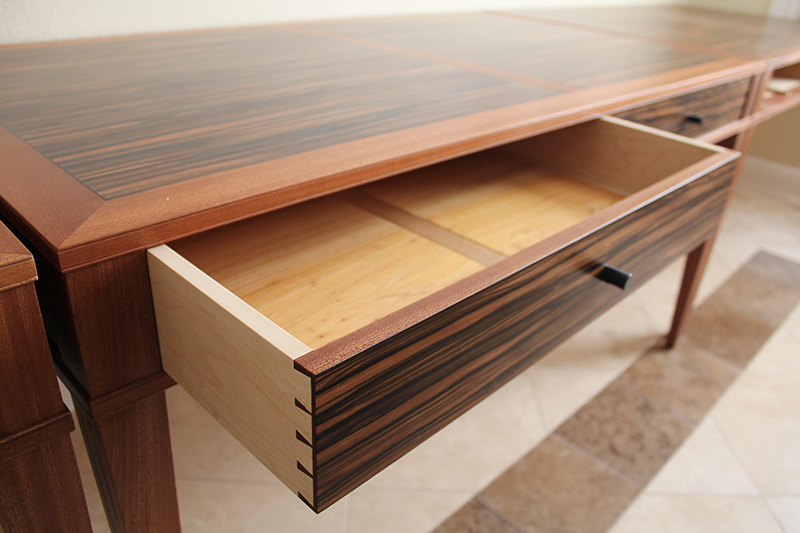
    We chose macassar ebony as the focal wood with mahogany as the skeleton of the piece. Macassar ebony comes in many forms and can differ greatly depending on the log/ tree it came from. I picked all my veneers to have a tight grain and arranged it so it’s not too busy, but not too plain to keep it from looking too much like commercial plywood or formica.

    [singlepic id=258 w= h= float=center]

    The drawers are handcut dovetail drawers with wooden center guide rails to keep the drawers tracking. The quietness of wooden drawers on wooden guides is a subtle cue into the attention and detail put into all aspects of the construction.

    [singlepic id=257 w= h= float=center]

    Im not sure how much the actual desks played a role in it, but it was reported to me that the kids have been getting significantly better grades since the desks have been delivery 🙂 

  • Ship Lap Island

    Ship Lap Island

    reclaimed-island5

    A real estate developer approached me with a challenge. He had an old 1930’s dilapidated home that was scheduled for demolishing, but he knew there was some nice old lumber used in the house so asked me to come up with some modern designs using the wood from this home. My first thought was “this is going to be a lot of work”, but when I saw the wood and started toying around with the idea, I couldn’t get it out of my head.

    [singlepic id=218 w= h= float=center]

    I knew many houses built back then used just nailed pine boards on the house framing as the wall and then plastered over it. As soon as I got permission, I started tearing the plaster off and what I found were beautiful, wide, ship lap pine with very little defects. I took off as much as I could grab in a day, and took it back to the shop to start pulling all the nails out.

    [singlepic id=219 w= h= float=center]
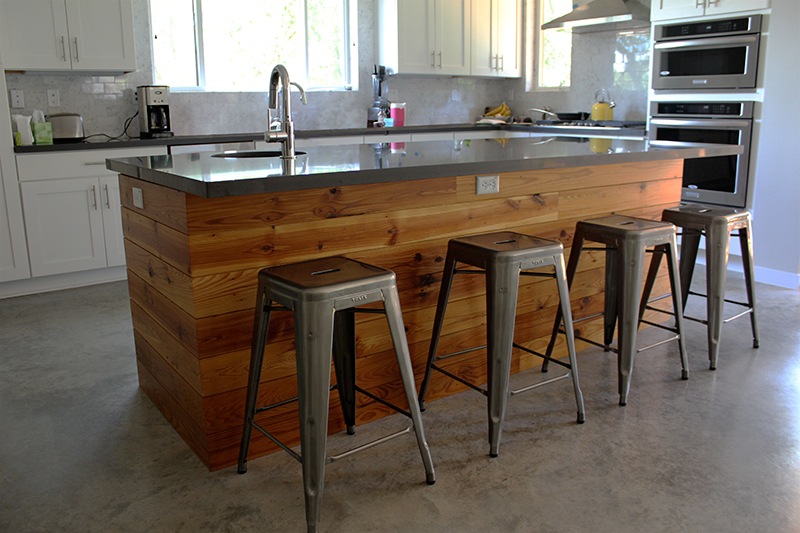
    We decided to use the recovered pine as the kitchen island. Using the pine for the kitchen island is a great use for it since the old growth pine would withstand all the beating of every day living over the years- especially with three kids running around. Usually, reclaimed pine is left with the patina and grime to keep that ‘reclaimed’ look, but I wanted something cleaner. The pine itself is old-growth pine so the tone is beautiful even when new wood is exposed. Rather than making the boards sit tight against each other like it was originally, we went for a little bit of a gap in between so we could accentuate the ship lap aspect part of the original wall and tie the history of the boards into the design. The difference in each board is a big part of the beauty of these boards, so we laid the boards out in a random pattern to bring out the individuality in each boards.

    [singlepic id=217 w= h= float=center]

    The kitchen island wraps from the back all the way to the side and then back around to the front. In the front, the pine wraps into the kitchen cabinets, tieing the whole kitchen together. In a modern room, this little island adds character, history, and warmth to this family in this new home.

    [singlepic id=220 w= h= float=center]

  • Christmas Jewelry Box

    Christmas Jewelry Box

    jbox5

    A good friend of mine approached me to make a jewelry box for his wife as a Christmas present. Before this commission, she was using a large plastic fishing tackle box to house her jewelry box. It was time for her to get a legitimate box she could call a jewelry box.  She loves jewelry and has a lot of it so that was the main focus- creating an elegant box large enough to house her jewelry, but doesn’t look clunky. I went for rippled English sycamore because a light wood make the whole thing feel lighter and I believe a jewelry box looks better in light wood. The rippled English sycamore gives enough figure and patterns to make the box beautiful without being too dramatic.

    [singlepic id=211 w= h= float=center]

    The necklaces take up the most space, so we went for as much necklace storage as possible. There are two doors on the sides that hinge open to hold necklaces. On the door there are hooks and a small shelf so that hanging necklaces don’t keep the door from closing. There is also a lift up top made of Sapele that opens to reveal a compartment for earrings, rings, and small jewelry. When the lift up top is closed, it locks the side necklace doors so it’s easier to move around if need be.

    [singlepic id=208 w= h= float=center]

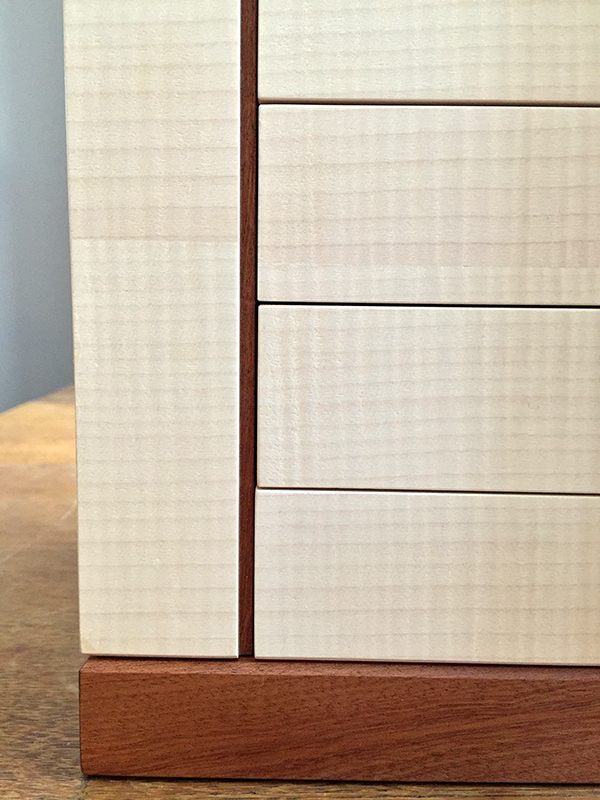
    There are 9 drawers- 3 long one and 6 mini ones, all with dividers in them. The drawers are made out of solid hard maple with splines in the corners to make it strong, as well as add a touch of decorative element. The dividers fit into the drawers using a birds mouth joinery, which make it possible to add dividers to thin wood without having to compromise the strength of the wood. I put in a green suede liner on the bottom to keep the jewelry from getting scratched up.

    [singlepic id=209 w= h= float=center]

    The style of this jewely box is definately modern/contemporary, but I hope the added details injects some warmth to the design. I believe it will only get better with age and become more joy to use the longer she uses it. The rippled sycamore is finished using Renaissance wax, a wax developed by British art conservationist.

    [singlepic id=210 w= h= float=center]

  • Sapele Round Table

    Sapele Round Table

    harmonsonround1

    This table was commissioned to be a meeting table for guests and clients at my client’s office. I had previously created other furniture for his office in a style that mixes traditional details and arranged in a modern way – Harmonson Desk & Harmonson Credenza. I wanted to keep those same ideas with this round table, so I worked on blending the traditional elements with modern elements without one being over bearing.

    [singlepic id=179 w=320 h=240 float=center]

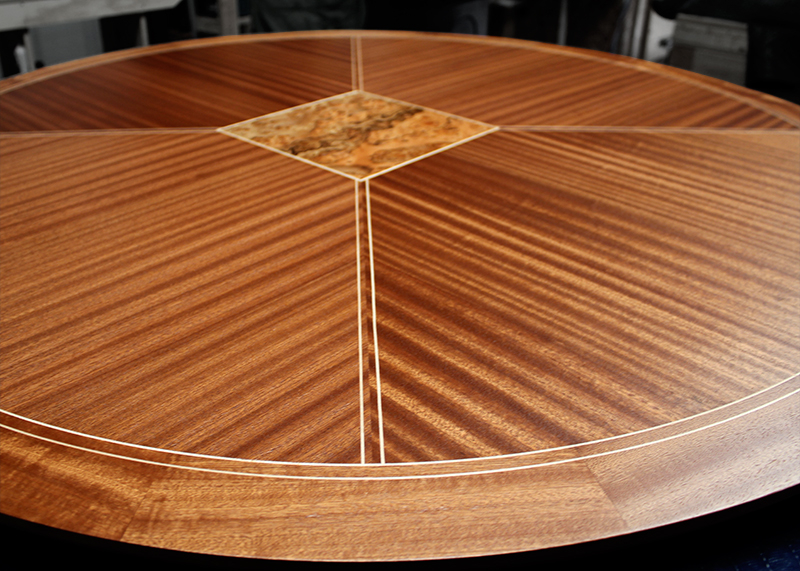
    The top is a beautiful 1/16″ thick ribbon striped sapele veneered top. The perimeter of the top is made out of solid wood not only for looks, but for protection. I arranged the sapele veneers in quarter section so that each quarter lines up to meet in the center. This pattern creates a V- pattern where each sections meet. Since I was able to get a nice consistent line, I didn’t want to hide it so I decided that instead of doing a single inlayed line, I would do a double line and have the V-pattern become another focal point. Having that double line also meant that the lines need to terminate to the perimeter in a thoughtful and graceful way so I decided on another double line that follows the curve of the top.

    [singlepic id=177 w=320 h=240 float=center]

    To keep the modern element, I decided on a tapered square pedestal base. The sapele is used again for the panels, which sticks out 3/16″ to create a three dimensional element. The framework is blackened hard maple. A lot of the design elements of this round table is actually based on a square- the tapered pedestal base and the top being broken into quarters- so I wanted to follow that theme and create a square centerpiece with a decorative wood (pepperwood burl). I think the square ties the top and the base together.

    [singlepic id=178 w=320 h=240 float=center]

    The square is oriented so it looks like a diamond with the double maple inlay stringing terminating at each of the corners. I’m very happy with the combination of sapele and pepperwood burl together. The tones compliment each other and the straight lines of sapele counter-act the free form wazy grain of the pepperwood burl.

    [singlepic id=176 w=320 h=240 float=center]