Tag: oak

  • Welder Console

    Welder Console

    tvconsole1

    My clients had been looking for years for a tv console to store all their media equipment in an elegant way. After countless frustrating hours and days of shopping online and going to other retail stores and not finding anything that would work for them, they were recommended to me by a mutual friend. Before they met me, they had no idea that people can get furniture made exactly the way they wanted to the dimensions that they needed it made to.

    [singlepic id=234 w= h= float=center]

    What they were looking for was fundamentally simple but the lack of customization that most retail furniture businesses offer made it difficult for them to find what they wanted. All they wanted was for their equipment to be hidden, have easy access to them when they need to switch out to new equipment as technology keeps changing , and for the speakers to be hidden. All of this while looking beautiful and built to last for generations.

    [singlepic id=235 w= h= float=center]

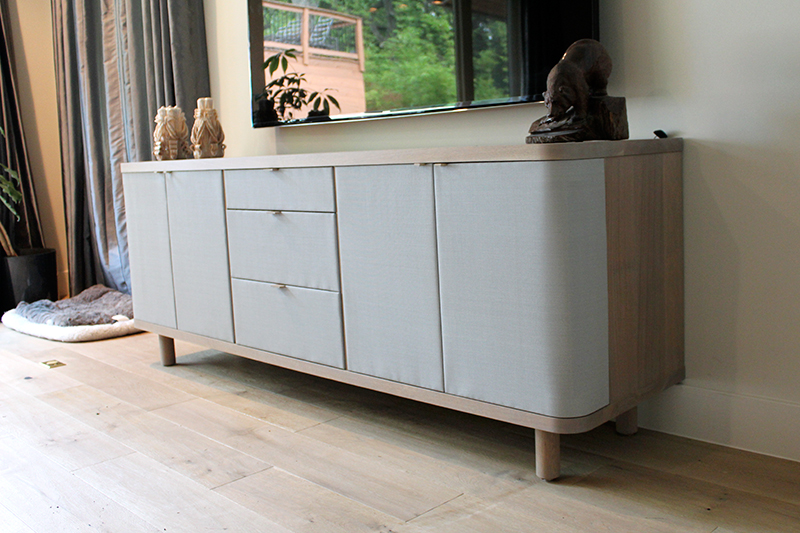
    After talking through them about the functional requirements for the piece, we started playing around with how it should look. They didn’t want anything that stands out too much and wanted it to blend in with the room. For the speakers to work inside the cabinet, we needed something that would let air flow through without disrupting sound. Also, since it’s a 4 speaker system, we needed to be able to space the speakers apart so the whole front side had to be wrapped in speaker cloth. The cloth also helped with ventilation problems that many media cabinets have. We decided on some nice speaker cloth made by accoustone and sold by accoustical solutions. They are professional grade speaker cloths with many different colors and textures to choose from. We took a functional requirement and turned it into a visual design feature.

    [singlepic id=238 w= h= float=center]

    The annoying part with any media cabinet is changing or wiring up new equipment. You have to reach in the back to a whole mess of cords and somehow finagle them through a small hole cut in the back of the cabinet. To make life easier, I made the back on this console removable in sections without any tools. Each section has a wide slot cut on the edge so no cords are ever trapped inside a hole. We left some gap between the wall and the back panel so that cords have some space to be wrapped up so it’s not just dangling down.

    [singlepic id=247 w= h= float=center]

    There are four doors on both ends- the furthest doors having a big radius on the corners. Bringing the speaker cloth around the corner like that lets the sounds escape in a much bigger area then if it was closed up the the sides. It also softens the credenza and keeps it from being too minimal and hard edged. The center bay has a drawer for remotes and other accessories at the top, a drawer that houses a center speaker, and the bottom part has a pull out tray that houses the receiver.

    [singlepic id=237 w= h= float=center]

    An unexpected feature that we didn’t think about with the speaker cloth is that when the lights are low, a diffused light from the receivers and equipment can be seen playing across the surface.
  • Antique Oak Shelf

    Antique Oak Shelf

    reclaimed-shelf3

    At the same house that we recovered the old growth pine from (read the last post here), there were also nice solid white oak flooring. Flooring has been reused as furniture in many different ways (mostly country style hutches or country style tables) but I wanted to use the flooring in a modern way. My client wanted to use the reclaimed lumber as a Tv stand so I took that idea and went for a long sleek floating shelf that sits under the television.

    [singlepic id=246 w= h= float=center]

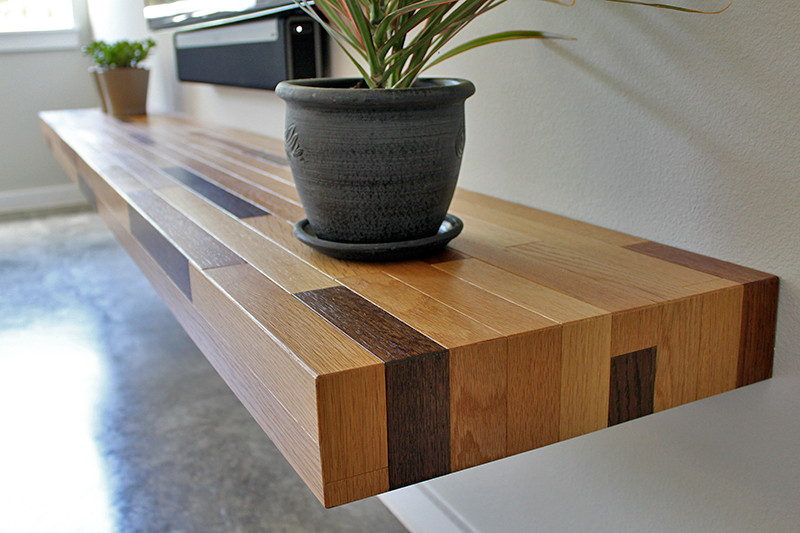
    I saw that the story behind the lumber was the highlight of this design so I didn’t want that aspect to get lost. The flooring was put down sometime in the 30’s and the tree that produced those flooring had several decades of life before it was even cut down- so these oak boards have a rich history. To bring the idea that these boards were used as flooring in it’s past life, I laid the boards out like regular flooring- with boards butting into the next board at irregular intervals. The actual recovered flooring was too wide to create a harmonious layout, so I cut down all the boards down to create better proportions. To further highlight the flooring, I put a slight bevel around each boards.

    [singlepic id=223 w= h= float=center]

    The story is the most important part, so I wanted the design to promote guests to ask about it and have conversations about it. I went with three different tones for the flooring. This further makes the flooring concept more concrete and creates an eye-catching detail. I thought that if I left the shelf as a monotone oak shelf, then guests would just think to themselves “oh that’s cool, they used flooring to make a shelf”- not pursuing the thought any further. Instead, I wanted the reaction to be more like “whoa, what’s going on there?”- and then hopefully that would invite the guests to inquire more about it.

    [singlepic id=222 w= h= float=center]

    The shelf looks simple to make, but there’s some technical elements that needed to be thought out before hand. First, we didn’t want any exposed hardware, so everything had to be hidden. Second, the shelf ends up around seat height and anything placed at seat height invites people to take a seat whether you want them to or not. Also, with three kids running around, I needed something strong enough to withstand them jumping and hanging from them. The shelf support bracket that I installed came from A&M hardware and it’s designed to hold a tremendous amount of weight but also remain hidden. The only catch is that they have to be installed before the drywall goes on- which wasn’t a problem for us because I was called in before the new house construction was too far along. The final installation has a 1/4″ oak plywood on the bottom to hide the hardware and construction when someone looks underneath the shelf.

    [singlepic id=224 w= h= float=center]

  • Lounge Chairs

    Lounge Chairs

    lounge2

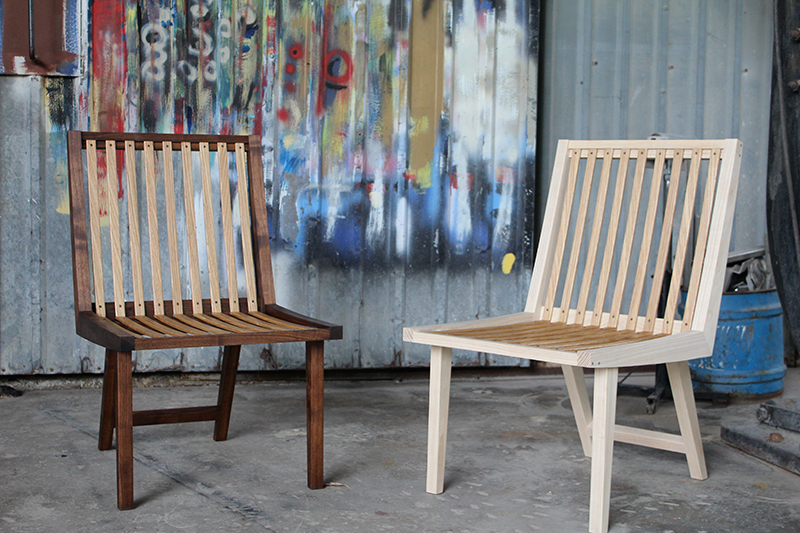
    I’ve always wanted to design and make my own chairs, but have never had the opportunity to do so, so I used the East Austin Studio Tour as a reason to design and make my first chair. Chairs are furniture that is the demands the most from craftsmen. First, it has to be strong enough to withstand all the weight and wracking force of the sitter. Then, it has to comfortable enough for the sitter to sit in for a long time. Then, it has to serve the function of that specific chair. A dining chair should be light and upright so it’s easy to move around and eat from. A lounge chair should be a little lower with more angle so it invites relaxation, but it shouldn’t be hard to get out of. And then finally, it has to look great. Not just from the front and sides, but from all angles.

    [singlepic id=189 w= h= float=center]

    For this chair, I went for unorthodox or different joinery methods so I can experiment and play around. Why make anything speculatively if you don’t push the limits, right? My design focus was for the seat and back to be one unit, and that these curved boomerang shapes will be the focus of the form. I brought the front legs from the sides and attaches to the side with an angled half lap joint with pegs to make it extra sturdy. I also brought the back legs in from the side and created the joinery so that the back legs are visually and physically holding the seat up. The angle of the legs makes the chair joint harder to break but it also keeps the sitter from being able to tilt the whole chair back on just the back legs. The back legs are mortise and tenoned in to the seat with dowels for extra grabbing power.

    [singlepic id=186 w= h= float=center]

    For the seat and back rest supports, I decided to laminate oak into curved slats that mimic the chair sides. The lamination makes it so I can get away with thinner material and makes the chair look nice with or without the upholstery. But just in case one of them does fail, I installed the slats using a dowel that has been hammered to create a mushroom like metal rivets. The wood rivets makes for a nice visual as well as tactile experience. I think the slats also make the piece look Nakashima-esque, but I may just be flattering myself.

    [singlepic id=185 w= h= float=center]

    You can’t have a lounge chair without cushions, so I commissioned my quilting and sewing friend Shannon Harris, to design and create the cushions to that would go well with the chairs. She came up with a simple and modern upholstery design using hexagons that compliments the lounge chairs well. I think the unique design fits in with the unique design of the chair perfectly. There is also a feeling of masculine and feminine to the chairs and upholstery by the wood and colors chosen. Also, for the show I asked Shannon to design a quilt that we could drape over the back of the chairs to create another layer. I also think it brings a feeling of warmth and that the furniture is ‘lived in’. The quilt is beautiful! the hexagon pattern flows from one corner to the other with changing tones. It speaks to the modern aesthetic while bringing warmth- which a lot of modern designs are lacking in.

    [singlepic id=215 w= h= float=center]

  • Stefanie Desk

    Stefanie Desk

    stephdeskThis client approached me wanting to create a desk for her fiance as a surprise christmas present. She liked the Harmonson desk I created earlier, and she also showed me several photos of a contemporary and minimalist design she liked. I took the common link between the two and came up with this design.

    [singlepic id=117 w=320 h=240 float=center]

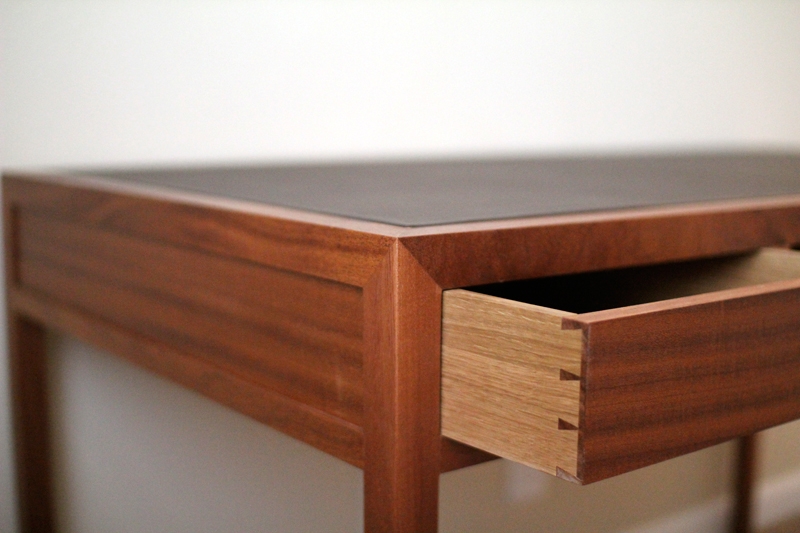
    This design is based off of the popular parson’s table. The minimal and clean look, I believe, is a timeless look. Where the legs meet the top, I decided to use a triple miter joinery. Most parson’s table made nowadays is mitered at the top, but the legs just butt up to the top, creating a weak joint. The triple miter, which was used extensively in chinese furniture, is a locking joinery. There are small tenons that lock into the mating surface, creating a joinery that is strong enough to stand even without glue- though glue is still used to make the joint even stronger.

    [singlepic id=118 w=320 h=240 float=center]

    The drawers are made from quartersawn white oak (which is stable and wear resistant) with hand cut dovetail joinery that ride on maple drawer guides (also wear resistant). I’m a big fan of drawers that slide against wood if it’s made and fitted well. It’s a subtle thing, but wood on wood drawers feel and sound better when used.

    [singlepic id=116 w=320 h=240 float=center]

    Other than the top and the drawers, the desk is made from Sipo Mahogany and Sapele panels . I used leather for the top because the client wanted the top to be made of another material and leather seemed very appropriate for this design. The leather helps to emphasize the frame work in the desk as well as making a nice writing surface. The dark tone of the leather will tie together nicely with the dark rubbed bronze of the handles manufactured by Linnea. (these photos don’t show the handles because I did not have the handles at the time of the photos. I will update with more photos when I take more photos.)