Tag: Shelves

  • Caswell 136 Shelf

    Caswell 136 Shelf

    shelf-136-1

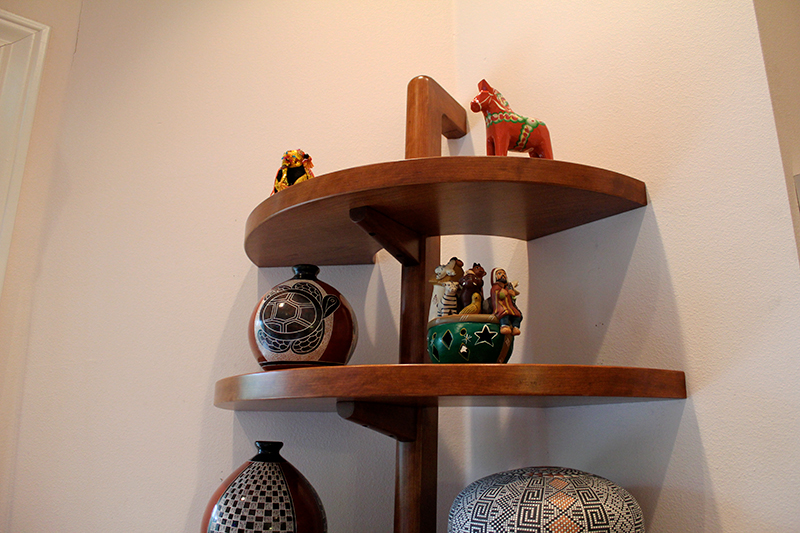
    My Client approached me to solve a problem they’ve been having for years. They have a large collection of art pieces they’ve collected on their travels but nowhere to show it off. The living room would be an ideal place for the shelf but there wasn’t a place that looked natural. They also didn’t want anything standard or ‘off the shelf’. The shelves should be something sculptural and visually pleasing by itself and would compliment the pieces shown.

    [singlepic id=193 w= h= float=center]

    The first problem we had to face was where to put the shelves. After some back and forth and several version and full scale models of the initial design, we came up with the perfect place for it. The only thing was that it was in a corner that made a 136 degree angle. To add to the difficulty of working with those angles, I designed the shelves into curved shelves, and to add to even that, the shelves are all different sizes, getting smaller the higher up the shelves went. Oh, and did I mention that the center support pole is angled?

    [singlepic id=195 w= h= float=center]

    Our concept of the design started as curved shelves with a single pole that supports the shelves. To me, the design has a feel of a Japanese paper umbrella mixed with Japanese folding fans. There is an open space behind the shelves where the pole connects to the shelf which lighten up the structure and make it where it doesn’t look like a ‘built in’ furniture, but more like a free standing furniture that’s just leaning against the wall.

    [singlepic id=194 w= h= float=center]

    of course, everything is anchored to the wall and floor so it’s super sturdy. The pole has limbs that come out that help support the bulk of the weight on the shelves. The limbs are joined to the center support pole using double mortise and tenon so there’s no worry about the shelves containing the priceless art work (and the memories attached to them) to ever come off and break. To keep the pieces from potentially sliding off, I also included a tiny lip around the perimeter of the shelf so it contains everything in.

    [singlepic id=192 w= h= float=center]

    The whole thing is made out of cherry with stain and finish to match the credenza I made for this client earlier this year.
  • Tambour sideboard

    Tambour sideboard

    sideboard9

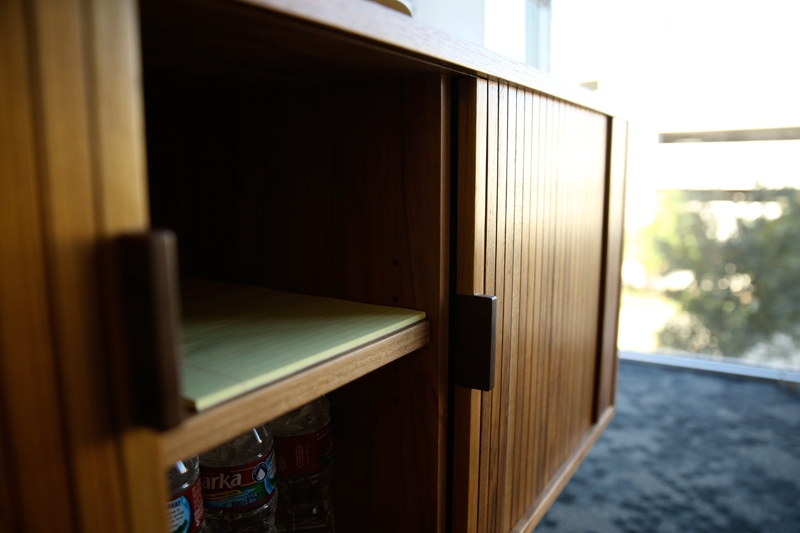
    I was approached to design a credenza/sideboard that matches a conference table I made in the past. A+L Conference Table. The main purpose for the sideboard was a storage unit that housed all their conferencing equipment when they weren’t using it as well as all the wires and misc things that should be hidden when it’s not used. The sideboard also makes a great platform to showcase all the awards they have won in the past.

    [singlepic id=124 w=320 h=240 float=center]

    Since there wasn’t a whole lot of space between the wall and the conference table chairs, I wanted to avoid having a door that swings out- especially if they needed the cabinet open for one reason or another. That left me with sliding doors or tambour doors as the options for the doors. Tambours are doors that slide in a track and roll so that it’s able to tuck into the sides and hide behind the back panel. You see this used on roll top desks.

    [singlepic id=127 w=320 h=240 float=center]

    After our design meeting, the client and I both agreed that tambours were the better choice for this situation. Not only does it look nicer, it’s a better solution functionally since you can reveal just the center shelf area, or open it all the way to showcase the whole interior of the cabinet. I also believe tambours have a certain nostalgic feeling that reminds us of beautiful furniture of the past.

    [singlepic id=130 w=320 h=240 float=center]

    The design inspiration came from mid-century modern furniture. I think the simplicity in form of the designers of this era got it just right. It’s hard to improve upon it, so I left the lines as clean as possible and tried to let all the details shine. Like many of SYD furniture, the eye is in the detail and the craftsmanship. Spend time on those elements and you don’t need fancy or unusual forms to stand out.

    [singlepic id=125 w=320 h=240 float=center]

    Most of the furniture in the room is made of pecan, so pecan was the natural choice of wood for this project. We didn’t want the room to look like a forest of pecan, so we decided to make the tambour doors out of a different, but complimentary wood. In this case, we decided on teak. The warm color of teak and the rich grain makes the door the focal point without taking all of the spotlight.

    [singlepic id=129 w=320 h=240 float=center]