Tag: Table

  • Milk Table

    The Milk Table came from my desire to create a smooth transition detail from a round leg to the table rails. It’s a simple detail, but adds a subtle touch to the piece. The shape of the transition detail is brought up to the top to create a fun detail I like to call furniture ears. There is a shelf at the bottom for unloading contents from the day.

    [supsystic-slider id=7]

    Features – curved smooth joinery detail, furniture ears
    Options – Top and shelf could be marble, small drawers could be added


    Dimensions: 54″ wide x 16″ deep x 33″ high.
    Finish: White Oil
    Materials: Maple


    Please Inquire for Pricing, Lead Times, and Customization.

  • Hafu Tables

    Hafu Tables

    The Hafu tables came from a single question. How thin can you make a wood table without it breaking? The answer was…pretty thin if you include metal in there. The exterior of the table is all wood, and the inside of the table is all metal. The glass top allows visibility to the construction of the different materials. The name Hafu came about from the Japanese fascination with mixed race. There are strengths and weaknesses of all materials, and with this design, it’s combined to utilize the strengths of all.

    [supsystic-slider id=6]

    Features – splined connection for the wood, welded metal for strength.
    Options – Metal could be left as blackened steel, Top could be stone, metal or even wood.


    Dimensions: 24″ wide x 24″ deep x 30″ high.
    Finish: Oil, Paint
    Materials: White Oak, Douglas Fir, Steel


    Please Inquire for Pricing, Lead Times, and Customization.

  • Carter Table

    Carter Table

    carter5
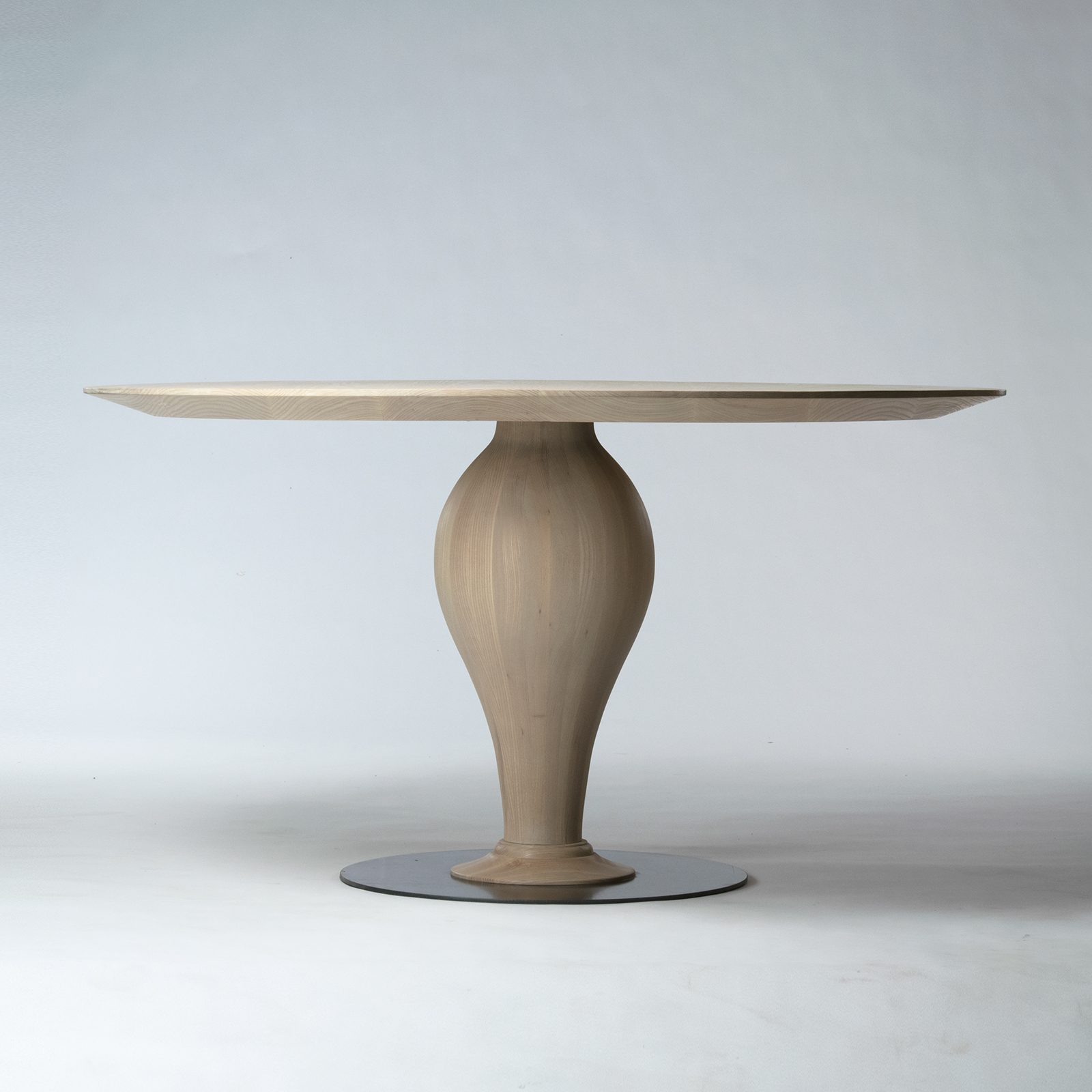
    Tim Cuppett Architects approached me with creating this table for a hill-country retreat they were creating for their client. The design process came about as a collaboration with them.

    They needed a kitchen table for everyday use that’s separate from the big dining room table. This would be the table they would use the most often for daily use- casual eating, conversations, homework, coffee drinking, etc. In other words, it had to be made to withstand the daily toil, but still be elegant. Space was limited, so the round table was a natural choice.

    [singlepic id=301 w= h= float=center]

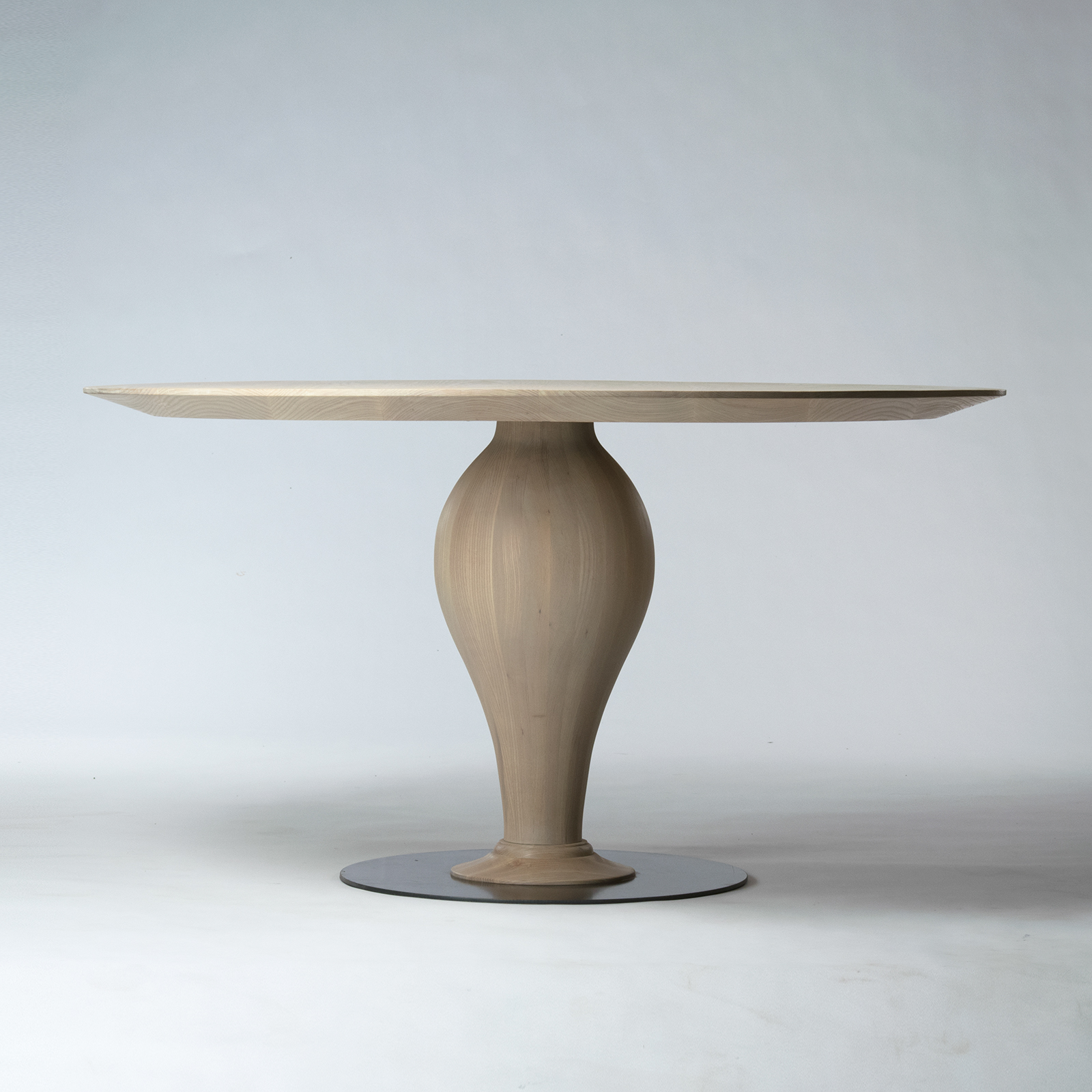
    The design was driven from the chair backs of the client’s family heirloom dining chairs. The chair had a queen anne style back, so we took that form and transformed it into the pedestal base. Because we didn’t want to see wood lamination joint lines as we cut the extreme curves, we glued up the base in a coopering technique. The ash wood was selected to get the straightest grain possible to keep the lines flowing smoothly.

    [singlepic id=299 w= h= float=center]

    The top is actually a thick top, but we cut a large bevel around the perimeter to create a knife edge to keep the top visually light. It also allows for more view of the pedestal base. There is a metal framework inlayed into the underside of the top to keep everything flat and allows for a strong connection to the base.

    [singlepic id=300 w= h= float=center]

    For a narrow pedestal base like this, the footing is always an issue. Most traditional pedestal bases have a large wooden structure (usually in a claw foot detail) that would have destroyed the whole look, so we went for a much cleaner and more modern look by adding a steel plate as the feet. Creating a thin profile for the bottom really highlights the shape of the pedestal without sacrificing structural integrity or making a tipsy table.

    [singlepic id=302 w= h= float=center]

    The table was finished in white oil that kept the wood looking as natural as possible.

  • Constantin Table

    Constantin Table

    Targu Jiu Table

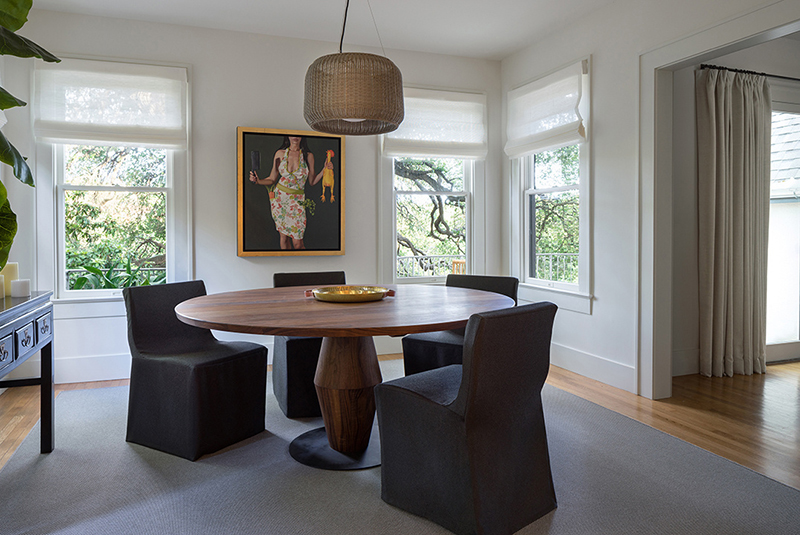
    This project was a collaboration piece with Tim Cuppett Architects here in Austin, Texas. They approached me looking to create an elegant round pedestal table for their client’s home they had been building. They wanted something modern and simple, but with enough details to make it a special central piece for their dining area.

    [singlepic id=279 w= h= float=center]

    We bounced ideas off of each other, and we finally came to this design inspired by Brancusi’s Endless Column in Targu Jiu. There are two tapered cones made with a coopering technique (like the oak barrels for wines and bourbons) that are mirrored and stack on top of each other. Those cones are then sandwiched by two round plate steels that have a long threaded rod connecting the two.

    The table is made out of American Walnut.

    The photography was taken by Whit Preston.

  • HEX game table

    HEX game table

    hex6

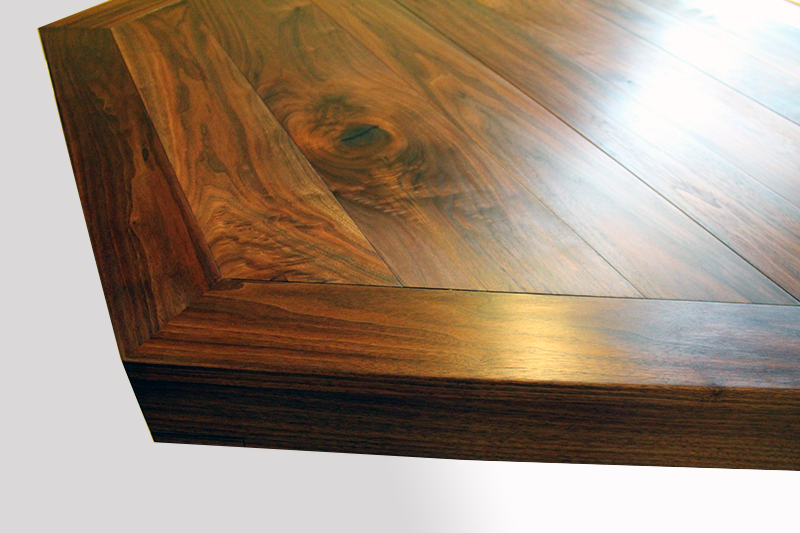
    My Client approached me wanting to create a game table for his family using his family Walnut that had been passed down the generation from his grandfather to his father and then down to him. My client would move the lumber everywhere he went until he could find out what exactly to build with it. 

    [singlepic id=251 w= h= float=center]

    Being an avid gamer, he and his family enjoys getting together to play role playing games where the games could go on for hours and possibly days. He wanted to be able to pause the game with all the pieces intact and in the meantime be able to keep everything from getting moved accidentally until the game would continue. After some research, we came to the split level design where the playing area is sunken in and there is a solid wood table top insert that can go on top to cover up the playing area. We also decided on having the game table hexagon shaped to better fit the room and so everyone is close together. 

    [singlepic id=252 w= h= float=center]

    The playing area is covered with gaming felt so it accommodates several types of games. There is also a plexi-glass insert so game maps can be inserted underneath without damaging it.

    [singlepic id=250 w= h= float=center]

    Since the table is six sided, we decided on a three-legged pedestal table base with a padauk inlay going down the center of each of the legs.

    [singlepic id=249 w= h= float=center]

    The client’s walnut had been air-dried so the walnut hadn’t lost it’s vibrant color as commercial steam dried walnut tends to do. Knowing that the lumber itself has a story makes it that much more of a pleasure to work with. I know this piece of furniture will be handed down the generations just like the lumber was.

    [singlepic id=248 w= h= float=center]

  • Sapele Round Table

    Sapele Round Table

    harmonsonround1

    This table was commissioned to be a meeting table for guests and clients at my client’s office. I had previously created other furniture for his office in a style that mixes traditional details and arranged in a modern way – Harmonson Desk & Harmonson Credenza. I wanted to keep those same ideas with this round table, so I worked on blending the traditional elements with modern elements without one being over bearing.

    [singlepic id=179 w=320 h=240 float=center]

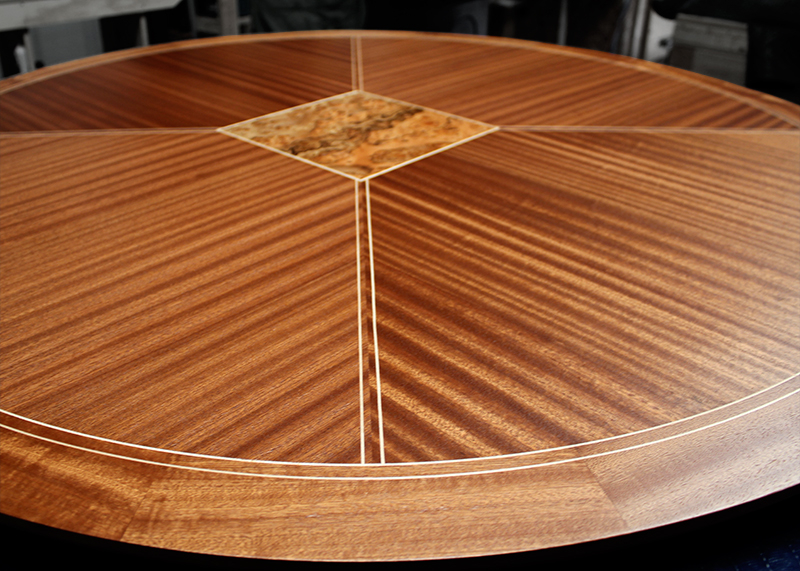
    The top is a beautiful 1/16″ thick ribbon striped sapele veneered top. The perimeter of the top is made out of solid wood not only for looks, but for protection. I arranged the sapele veneers in quarter section so that each quarter lines up to meet in the center. This pattern creates a V- pattern where each sections meet. Since I was able to get a nice consistent line, I didn’t want to hide it so I decided that instead of doing a single inlayed line, I would do a double line and have the V-pattern become another focal point. Having that double line also meant that the lines need to terminate to the perimeter in a thoughtful and graceful way so I decided on another double line that follows the curve of the top.

    [singlepic id=177 w=320 h=240 float=center]

    To keep the modern element, I decided on a tapered square pedestal base. The sapele is used again for the panels, which sticks out 3/16″ to create a three dimensional element. The framework is blackened hard maple. A lot of the design elements of this round table is actually based on a square- the tapered pedestal base and the top being broken into quarters- so I wanted to follow that theme and create a square centerpiece with a decorative wood (pepperwood burl). I think the square ties the top and the base together.

    [singlepic id=178 w=320 h=240 float=center]

    The square is oriented so it looks like a diamond with the double maple inlay stringing terminating at each of the corners. I’m very happy with the combination of sapele and pepperwood burl together. The tones compliment each other and the straight lines of sapele counter-act the free form wazy grain of the pepperwood burl.

    [singlepic id=176 w=320 h=240 float=center]