Tag: Table

  • Outdoor Tables + Benches

    Outdoor Tables + Benches

    bergoutdoor1

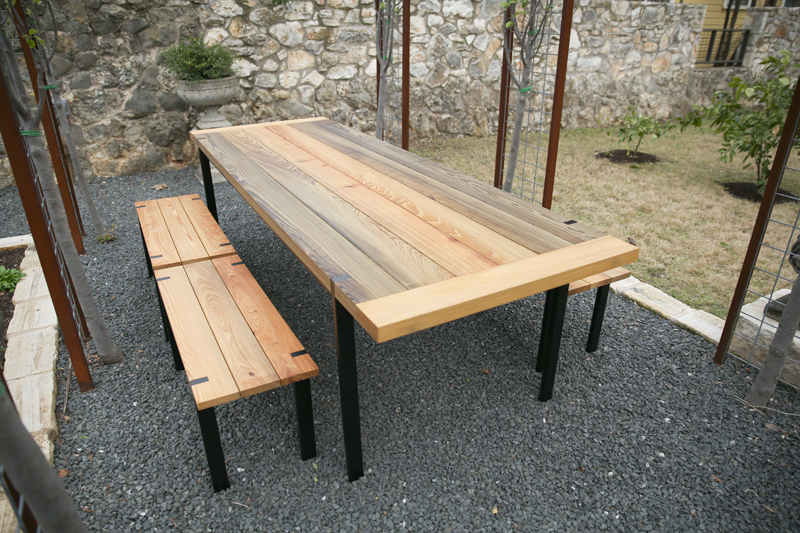
    My clients have a backyard garden area that would be the envy to anyone. The landscape architect designed an elegant area where people can hang out and socialize next to freshly growing vegetables, with the smell of smoke and cooking from the grill, and enjoying good company under an arbor with fruitless bradford pear trees

    [singlepic id=152 w=320 h=240 float=center]

    The arbor  was started a few years ago and is just now getting to be filled out so my clients wanted to get a nice outdoor table to dine under. They wanted something classy that blends in with the landscape, but without being too rustic. They have a few stone sculptures that reminded me of a Tuscan winery so I started looking for inspiration in books, but all I could see were weathered and beaten up gray farm style tables. That weathered look is nice, but I didn’t think it would look good in their backyard. I also think people should grow up with their furniture and see it weather themselves through the years instead of getting furniture already weathered- their history unknown.

    [singlepic id=150 w=320 h=240 float=center]

    I took inspiration from the arched arbors. At first I wanted to incorporate arches into the design but decided that it was too obvious and predictable so I took the same elements from the supports that hold up the arches. The archway supports were made from 1″x2″ rectangular tubing, so that became my choice of material. When you step away from under the archway, the 1×2 lines going vertical becomes a strong element so I wanted to emphasize that vertical line. To do that, I let the legs shoot straight through the top so it’s visible from all around. This cohesion actually makes the two different material distinct in my opinion. In a lot of the metal and wood furniture on the market out there, the difference of metal and wood becomes kind of lost. Usually, the wood just sits on top or is let into a metal frame.

    [singlepic id=154 w=320 h=240 float=center]

    Now, the question was the wood. I was looking at using cypress, but on my drive to meet my metal worker in Elgin, I saw a sign on the side of the road ‘Sinker Cypress’. Sinker Cypress is logs that have been submerged underwater for decades and sometimes centuries. The logging industries used to float logs down the river as a means of transportation to the milling factories, but sometimes the logs sink underwater and was forgotten until recently. Recently, loggers have found these old cypress logs that have been preserved underwater due to the lack of oxygen. Sinker cypress has beautiful colors ranging from olive to gold. To read more about it, visit here.

    [singlepic id=157 w=320 h=240 float=center]

    One thing I don’t like about picnic tables is that the ends of the boards start moving and becomes misaligned. To help with this issue, I decided to add a breadboard on the ends. This breadboard will keep the many boards aligned and also helps to cover up the endgrains (end of the board) since endgrain is like a straw- it sucks up the moisture. To help shed water, the boards have 1/8″ gap between the boards. The sinker cypress is finished using Penofin, which is a type of outdoor oil designed for decking and siding. It’s not the most durable finish out there, but it’s easy to fix and maintain.

    [singlepic id=153 w=320 h=240 float=center]
  • FWC-18′ conference table

    FWC-18′ conference table

    fwc18-9

    The good people of Far West Capital are so awesome that their business and staff just keeps getting bigger and bigger. I had made a 12′ conference table for them a few years ago, and they’ve already outgrown that one, so they commissioned me to make a 18′ conference table this time. They loved the traditional meets modern aesthetic of the last one, so we decided to design something that looks totally different from the last one, yet feels similar.

    [singlepic id=162 w=320 h=240 float=center]

    This was by far the biggest project I’ve had the opportunity to work on and logistics became the first and foremost in the design aspect. How can I make these parts in my shop and how can I break the pieces up so I can move it safely and easily? I decided that the top will be made from 3 parts and I wanted to make the top as light as possible since that has the biggest area. To support the top, there are thick and wide aprons that come apart and fit together with notches made in the wood. This gives stability to an otherwise flexible top. The aprons rest on pedestals that are angles and tapered in almost every direction. The taper came from trying to gain as much foot space as possible without sacrificing stability. One side of the pedestal is held in with clips so you can remove it to store and hide conference table equipment. At the feet there is a 1/4″ blackened plate steel that adds weight and distributes the footprint out so the top wont tip over.

    [singlepic id=145 w=320 h=240 float=center]

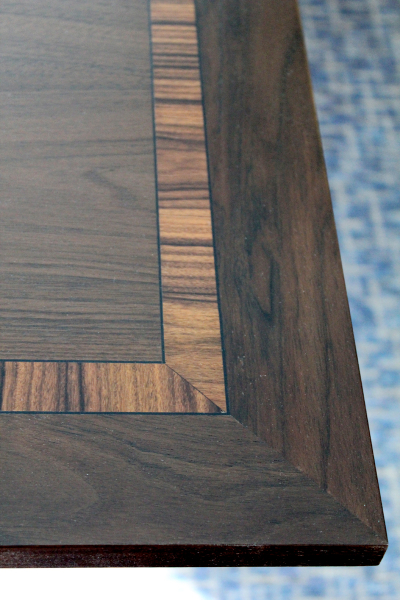
    The whole table is made from peruvian walnut veneered panels with solid wood edging. The removable center piece is made of spalted beech. Spalted is a figure in wood caused by fungal attack. The wood is left for fungus to attack, but then harvested before the wood rots completely and becomes unusable. It’s characteristics are black vein like lines with wood tones around it being different. I think the spalted beech was a nice compliment to the peruvian walnut and adds a little bit of country to the otherwise sophisticated elements.

    [singlepic id=147 w=320 h=240 float=center]

    To break up the large dark surface and to give a nod to traditional furniture we chose to inlay cross banding around the border. Cross banding is inlayed wood that is aligned so the grain is oriented side to side across the length. The outer cross banding is made from Bolivian rosewood and the inner cross banding that borders the spalted beech is Macassar Ebony. I feel the different tones in the woods give a nice transition to the different woods.

    [singlepic id=144 w=320 h=240 float=center]

    Sixteen people can sit all around the table easily and maybe a few more if people are willing to get close and cozy with each other. I think this design is a success because the real design elements are in the small details.


  • Stefanie Desk

    Stefanie Desk

    stephdeskThis client approached me wanting to create a desk for her fiance as a surprise christmas present. She liked the Harmonson desk I created earlier, and she also showed me several photos of a contemporary and minimalist design she liked. I took the common link between the two and came up with this design.
    [singlepic id=117 w=320 h=240 float=center]

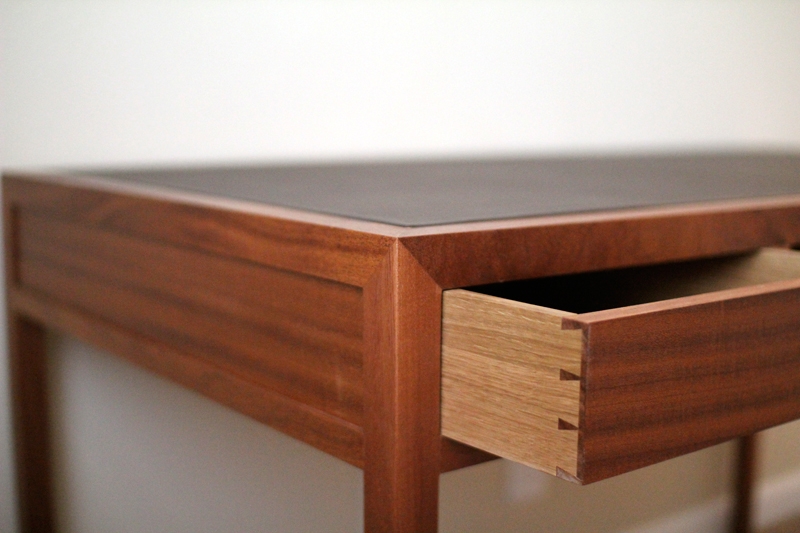
    This design is based off of the popular parson’s table. The minimal and clean look, I believe, is a timeless look. Where the legs meet the top, I decided to use a triple miter joinery. Most parson’s table made nowadays is mitered at the top, but the legs just butt up to the top, creating a weak joint. The triple miter, which was used extensively in chinese furniture, is a locking joinery. There are small tenons that lock into the mating surface, creating a joinery that is strong enough to stand even without glue- though glue is still used to make the joint even stronger.

    [singlepic id=118 w=320 h=240 float=center]

    The drawers are made from quartersawn white oak (which is stable and wear resistant) with hand cut dovetail joinery that ride on maple drawer guides (also wear resistant). I’m a big fan of drawers that slide against wood if it’s made and fitted well. It’s a subtle thing, but wood on wood drawers feel and sound better when used.

    [singlepic id=116 w=320 h=240 float=center]

    Other than the top and the drawers, the desk is made from Sipo Mahogany and Sapele panels . I used leather for the top because the client wanted the top to be made of another material and leather seemed very appropriate for this design. The leather helps to emphasize the frame work in the desk as well as making a nice writing surface. The dark tone of the leather will tie together nicely with the dark rubbed bronze of the handles manufactured by Linnea. (these photos don’t show the handles because I did not have the handles at the time of the photos. I will update with more photos when I take more photos.)

  • Outdoor Bench with Sliding Table

    Outdoor Bench with Sliding Table

    berbench2

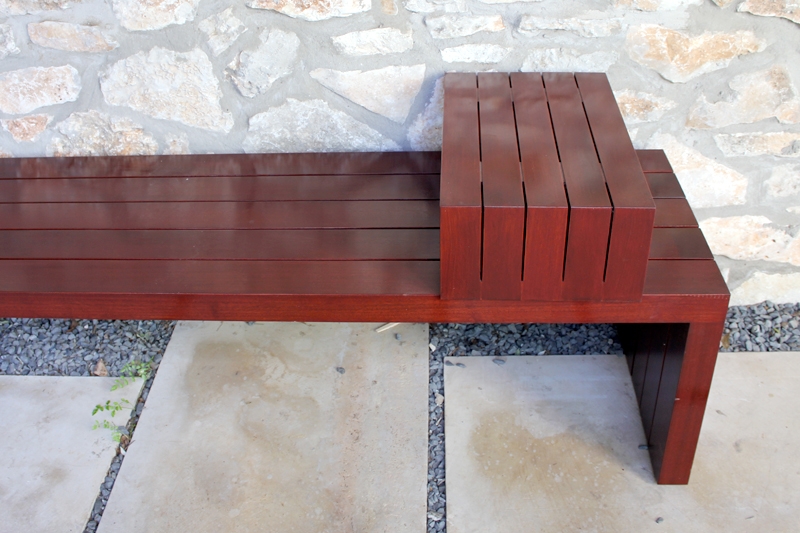
    This outdoor bench was made to fit against a stone wall at my client’s backyard garden. We wanted to highlight the stone wall since it was one of the key features that tied the whole backyard together. We decided to use clean, simple, lines to design the bench. The bench uses 2 1/2″ thick boards of mahogany since it needs to span 8 feet, but it also gives the bench a visual weight that helps to make the simple lines bold. The stone wall can be used as a back rest. The use of natural materials used in this raw way is appealing to me. There’s little frou frou and the heaviness of each of the materials fits with the concept of the outdoor space.

    [singlepic id=91 w=320 h=240 float=center]

    [singlepic id=92 w=320 h=240 float=center]

    The garden backyard was designed not only as a garden, but also as a social place where guests can enjoy each other’s company outdoors as many people here in Austin love to do. With that in mind, we designed the bench with a table that slide along the length of the bench. This sliding table serves not only to hold guest’s drinks or plates, but it also gives more flexibility to different kinds of guests. If there’s a couple that want to sit next to each other, then move the table over. If you just want to sit with a friend for a chat, then you can also share the table by sliding it in between. Maybe someone is telling a story and everyone wants to sit on the bench, then you can roll the table off to squeeze another person in.

    [singlepic id=93 w=320 h=240 float=center]

    [singlepic id=90 w=320 h=240 float=center]

    The bench is finished using Sikkens Cetol 1+23 system.

    [singlepic id=94 w=320 h=240 float=center]

  • The Johansen Table

    The Johansen Table

    img_4008

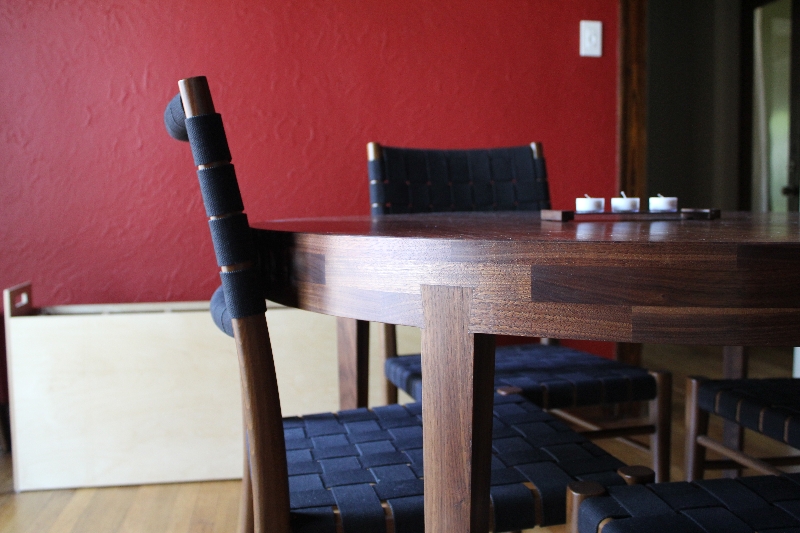
    This client wanted a dining table that would fit into their tight dining area.They love to entertain, so the dining table had to be able to expand to seat more people.The circular dining table is constructed in two halves with sliding aprons that hold two extra leaves. My clients love the danish modern look of sleek and clean but also keeping the depth and character of the wood alive. What we came up with is a design that takes inspiration from Harry Ostergaard. The Johansen table is constructed with stack lamination for the apron with a tapered leg attached by a dovetail joinery.

    [singlepic id=85 w=320 h=240 float=center]

    Traditionally, when building a circular table, craftsmen would stack laminate their aprons out of inferior woods like poplar and then veneer the face of it with beautiful wood like mahogany or rosewood. To me, the different layers and the changing grains of the stack lamination is beautiful in itself, so I decided not to cover it up, but turn it into a design element. We ended up with the dovetail joinery for the legs because it was the most honest connection. Anyone looking at it can visually see that the legs aren’t coming apart.

    [singlepic id=87 w=320 h=240 float=center]

    The table is all constructed out of American Black Walnut except for the Maple sliding rails for the extra leaves. It is finished with a hand rubbed oil finished off with a layer of wax.
    [singlepic id=86 w=320 h=240 float=center]